
Sell Your House Fast in Brooklyn, NY — Understand All Your Options (2026)
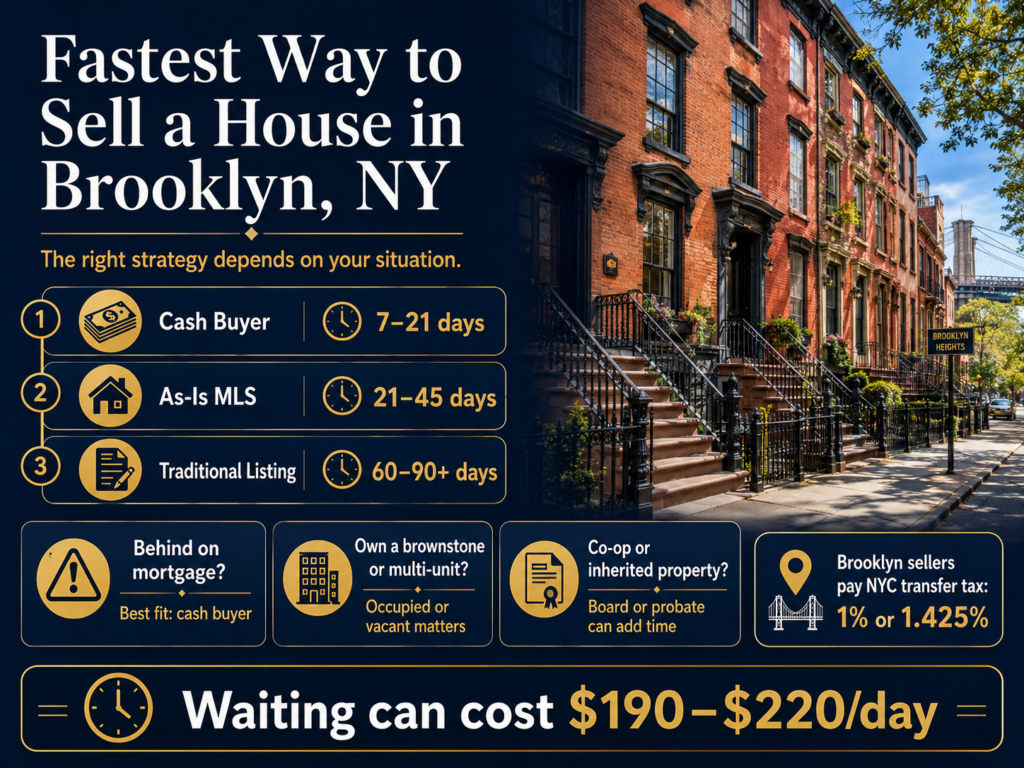
The fastest way to sell a house in Brooklyn, NY depends entirely on your situation — not just your timeline. A homeowner in East New York facing pre-foreclosure needs a completely different strategy than someone in Park Slope with a renovated brownstone and 90 days to spare. A tenant-occupied two-family in Flatbush calls for a different approach than a vacant condo in Downtown Brooklyn.
This guide is organized by situation. Find the one that matches yours, understand which selling method fits it best, and know exactly what to expect — timeline, costs, and the Brooklyn-specific factors that change the calculation.
Legal note: This guide provides general information about New York City real estate law and the Brooklyn market. It is not legal advice. Consult a New York real estate attorney before making decisions about your specific situation.
Table of Contents
- What Selling Fast Actually Means in Brooklyn
- Brooklyn vs. Queens and Nassau: Key Differences for Sellers
- Match Your Situation to the Right Strategy
- The 3 Fastest Ways to Sell in Brooklyn
- Cash vs. Listing: The Real Net Proceeds Comparison
- NYC Taxes Every Brooklyn Seller Needs to Know
- Brooklyn Neighborhoods: Cash Buyer Activity by Area
- Frequently Asked Questions
What Selling Fast Actually Means in Brooklyn
The short answer: 10 to 21 days with a cash buyer, 21 to 45 days with an as-is listing, and 60 to 90+ days with a traditional realtor listing. Which timeline applies to you depends almost entirely on the selling method you choose — not on market conditions, the time of year, or your neighborhood.
In Brooklyn’s 2026 market, the median single-family home sold for approximately $850,000 to $939,000 — up 4 to 5 percent year-over-year. The borough averages 62 days on market, but well-priced renovated homes move in 18 to 22 days while properties needing work average 35 or more days. Brooklyn operates in a competitive seller’s market, but that does not mean every home sells quickly or at asking price. Condition, pricing, and property type all determine individual outcomes.
The cost of waiting in Brooklyn: At $190 to $220 per day in carrying costs for a typical Brooklyn homeowner with a mortgage, every unnecessary month costs $5,700 to $6,600. The method you choose has a direct, measurable impact on your net proceeds.
| Method | Phases Eliminated | Timeline | Trade-off |
|---|---|---|---|
| Cash buyer | Prep, showings, financing wait | 7–21 days | Offer at 80–90% of market value |
| As-is MLS listing | Prep and repairs only | 21–45 days | Wider buyer pool, some deal risk |
| Traditional listing | None eliminated | 60–90+ days | Closest to full market value |
| Co-op sale | None — board adds phases | 90–150 days | Board approval adds 30–60 days post-acceptance |
Brooklyn vs. Queens and Nassau: Key Differences for Sellers
| Factor | Brooklyn (Kings County) | Queens | Nassau County |
|---|---|---|---|
| Median single-family (2026) | $850,000–$939,000 | $830,000 | $480,000–$520,000 |
| Median co-op | $380,000–$420,000 | Varies widely | Less common |
| Days on market | 62 days avg. | 48–65 days | 25–28 days |
| Surrogate’s Court (probate) | 2 Johnson St, Brooklyn 11201 | 88-11 Sutphin Blvd, Jamaica | Mineola |
| Foreclosure court | Kings County Supreme Court, 360 Adams St, Brooklyn | Queens Supreme Court, Jamaica | Nassau Supreme Court, Mineola |
| NYC Transfer Tax | 1% or 1.425% | 1% or 1.425% | Not applicable |
| Brownstone inventory | Dominant property type in many neighborhoods | Rare | Rare |
| Co-op concentration | Significant — 38% of condo/co-op inventory | Significant | Minimal |
Kings County: Brooklyn is Kings County for legal purposes. All probate matters go to the Kings County Surrogate’s Court at 2 Johnson Street, Brooklyn, NY 11201. All foreclosure actions are filed at Kings County Supreme Court at 360 Adams Street, Brooklyn, NY 11201. Both are critical addresses for Brooklyn homeowners facing legal matters related to their property.
Match Your Situation to the Right Strategy
Situation 1: You Are Behind on Mortgage Payments or Facing Pre-Foreclosure
Best strategy: Cash buyer, immediately.
Brooklyn has significant pre-foreclosure activity concentrated in East New York, Brownsville, Canarsie, Flatbush, and East Flatbush. East New York in particular has the highest foreclosure rate in Brooklyn and one of the highest in all of NYC — while simultaneously experiencing the highest appreciation rate in the borough at 9.2% year-over-year in 2026 due to its Opportunity Zone designation. That combination means homeowners in East New York may have more equity than they realize — equity that a cash sale can capture before foreclosure erases it.
All Brooklyn foreclosure actions are filed and heard at Kings County Supreme Court, 360 Adams Street, Brooklyn, NY 11201.
You Own a Brownstone or Multi-Unit Property
Best strategy: Cash buyer experienced with Brooklyn multi-unit properties, or targeted MLS listing depending on vacancy and condition.
Brooklyn brownstones are the borough’s most iconic property type — and one of its most complex to sell. A typical Brooklyn brownstone is a 2 to 4 unit building where the owner may occupy one floor and rent the others. This creates layered selling complexity: NYC tenant rights govern access and notice requirements, each unit may have different tenancy arrangements, and the property’s income-generating potential affects how investors calculate value.
Cash buyers who specialize in Brooklyn multi-unit properties understand brownstone valuation — both the comparable sales approach and the income-based cap rate method — and purchase occupied properties without requiring vacancy first.
You Own a Co-op and Need to Sell
Best strategy: Traditional MLS listing with an agent experienced in Brooklyn co-op sales.
Co-ops make up approximately 38% of Brooklyn’s condo and co-op inventory — particularly in neighborhoods like Bay Ridge, Sheepshead Bay, Flatbush, and Midwood. Selling a co-op is fundamentally different from selling a house: you are selling shares in a corporation, not the real property itself. Every buyer must be approved by the co-op board, which can take 30 to 60 days post-acceptance and can result in outright rejection.
Cash buyers who purchase investment properties typically cannot pass co-op board approval — they do not meet owner-occupancy requirements most boards impose. For co-op sales, a traditional listing targeting qualified owner-occupant buyers is almost always the only viable path.
You Are Relocating for Work
Best strategy: Cash buyer if under 30 days. As-is listing if 45 to 60 days.
Brooklyn’s 62-day average DOM means a traditional listing frequently runs past a relocation deadline even when it starts on time. A cash buyer lets you set an exact closing date — no risk of a financing fallthrough or co-op board rejection leaving you scrambling with a hard start date already set.
You Inherited a Property in Brooklyn
Best strategy: Cash buyer or as-is listing, depending on condition and probate status.
Brooklyn inherited properties run the full value spectrum — from co-ops in Sheepshead Bay at $380,000 to brownstones in Park Slope or Carroll Gardens approaching $3 million or more. The stepped-up basis benefit is particularly significant in Brooklyn given decades of appreciation. All Brooklyn probate matters are handled at the Kings County Surrogate’s Court, 2 Johnson Street, Brooklyn, NY 11201.
Your Property Needs Significant Repairs
Best strategy: Cash buyer in most cases.
Brooklyn’s housing stock includes a significant amount of pre-war construction — row houses, brownstones, and two-family homes built in the early 1900s through the 1940s. Deferred maintenance, knob-and-tube wiring, aging boilers, and structural issues are common in older Brooklyn neighborhoods. These problems frequently cause traditional sales to collapse at inspection after 30 to 45 days of process. Cash buyers factor repair costs directly into their offer and purchase as-is.
You Are Going Through a Divorce
Best strategy: Cash buyer or as-is listing — whichever both parties can agree on quickly.
A cash sale simplifies a divorce property transaction to the fewest joint decisions. In Brooklyn, where brownstone rental income is frequently part of the marital estate, having a concrete written offer on the table resolves disagreements that abstract listing price negotiations cannot. Contested property matters are handled at Kings County Supreme Court, 360 Adams Street, Brooklyn, NY 11201.
→ Full guide: Selling a House During Divorce in Brooklyn, NY
Your Home Is in Good Condition and You Have Time
Best strategy: Traditional listing with a real estate agent.
Brooklyn’s 2026 market — with limited inventory in popular neighborhoods and sustained demand across price points — rewards well-prepared properties. Park Slope, Carroll Gardens, Cobble Hill, Boerum Hill, Prospect Heights, and Williamsburg consistently produce competitive bidding on prepared listings. If your property is in good condition and you have 60 to 90 days, run the full net proceeds comparison before defaulting to a cash sale. At Brooklyn’s price points, the math may favor the traditional route by more than you expect.
The 3 Fastest Ways to Sell a House in Brooklyn
1. Sell to a Cash Buyer
The fastest option available for houses, brownstones, condos, and multi-family properties.
- Timeline: 7 to 21 days from accepted offer to closing
- No repairs, staging, or showings required
- Buyer typically covers NYC Transfer Tax (1% or 1.425%) and closing costs
- Works for single-family, two-family, brownstones, condos — not co-ops
- Offer typically 80 to 90 percent of market value
2. Sell As-Is on the MLS
List in current condition targeting investors and owner-occupants willing to renovate.
- Timeline: 21 to 45 days depending on buyer financing
- No repairs required, but marketed to financed buyers
- Price closer to market value than a direct cash offer
- Risk: FHA and VA loans have minimum property standards many older Brooklyn properties do not meet
- Not viable for co-ops — board approval required regardless
→ Sell a house as-is in Brooklyn, NY
3. List With a Real Estate Agent
- Timeline: 60 to 90+ days; 90 to 150 days for co-ops including board approval
- Agent commission: typically 5 to 6 percent of sale price
- On an $850,000 Brooklyn home: $42,500 to $51,000 in commission
- NYC Transfer Tax adds 1% to 1.425% on top of NY State transfer tax
- Best for: properties in good condition, sellers with 60 to 90 days of flexibility
Cash vs. Listing: The Real Net Proceeds Comparison
| Cost Item | Cash Buyer | Traditional Listing |
|---|---|---|
| Sale price (example) | $730,000 | $900,000 |
| Agent commission (5.5%) | $0 | −$49,500 |
| NYC Transfer Tax (1.425%) | $0 (buyer covers) | −$12,825 |
| NY State Transfer Tax (0.4%) | $0 (buyer covers) | −$3,600 |
| Attorney and closing costs | $0 | −$5,000 |
| Repairs before listing | $0 | −$40,000 |
| Carrying costs (4 months) | $0 | −$22,400 |
| Net proceeds | $730,000 | $766,675 |
| Timeline | 14 days | 4–5 months |
The real gap is $36,675 — not $170,000. For most Brooklyn homeowners with a property needing moderate work, the cash sale closes 4 months faster for a fraction of the apparent price difference. Run this calculation with your actual numbers before making any decision.
NYC Taxes Every Brooklyn Seller Needs to Know
NYC Transfer Tax
- Properties sold for under $500,000: NYC Transfer Tax of 1%
- Properties sold for $500,000 or more: NYC Transfer Tax of 1.425%
- NY State Transfer Tax: 0.4% on all sales
- On an $850,000 Brooklyn sale: combined transfer taxes of approximately $15,513
NYC Mansion Tax (Paid by the Buyer)
For residential properties selling at $1 million or more, the buyer pays an additional NYC Mansion Tax ranging from 1% to 3.9%. In Brooklyn, where brownstones and renovated properties in desirable neighborhoods regularly sell above $1 million, this tax affects buyer purchasing power and can influence negotiations on higher-priced properties.
Brooklyn Property Taxes
Brooklyn properties are assessed under NYC’s four-class property tax system administered by the NYC Department of Finance — the same system as Queens, but different from Nassau and Suffolk counties.
- Class 1 (1-3 family homes including brownstones): effective rate approximately 0.88%
- Class 2 (co-ops, condos, 4+ unit buildings): assessment ratio 45%, significantly higher effective rate
- Annual property taxes for Class 1 Brooklyn properties average $5,500 to $10,000 depending on neighborhood and assessed value
Brooklyn Neighborhoods: Cash Buyer Activity by Area
| Neighborhood | Cash Buyer Activity | Typical ARV Range | Notes |
|---|---|---|---|
| East New York | Very High | $550,000–$750,000 | Highest appreciation in Brooklyn (+9.2% YoY), Opportunity Zone, highest pre-foreclosure concentration |
| Brownsville | Very High | $500,000–$680,000 | Active investor market, significant distressed inventory |
| Flatbush / East Flatbush | High | $650,000–$850,000 | Strong Caribbean community buyer pool, active two-family market |
| Canarsie | High | $650,000–$800,000 | Waterfront proximity, active investor demand, appreciating rapidly |
| Crown Heights | High | $800,000–$1.1M | Gentrification premium; brownstone buyers active |
| Bed-Stuy | High | $850,000–$1.3M | Brownstone market; priced-out buyers from Park Slope driving demand |
| Bushwick | Moderate | $700,000–$1.0M | Younger buyer demographic; artist community; steady appreciation |
| Bay Ridge | Moderate | $750,000–$950,000 | Family-oriented; relatively affordable for Brooklyn; steady DOM |
| Park Slope / Carroll Gardens | Lower | $1.2M–$3M+ | Premium market; less distressed inventory; retail buyers dominate |
What is the fastest way to sell a house in Brooklyn, NY?
Selling to a verified cash buyer is the fastest option — 7 to 21 days from accepted offer to closing. No repairs, no showings, no financing contingencies. This applies to houses, brownstones, condos, and multi-family properties. Co-ops are the exception — cash buyers cannot typically pass co-op board approval, making a traditional MLS listing the only viable path for co-op sales.
Is it a buyer’s market or seller’s market in Brooklyn in 2026?
Brooklyn remains a seller’s market overall, but conditions vary significantly by neighborhood. Premium neighborhoods like Park Slope, Carroll Gardens, and Williamsburg remain highly competitive. East Brooklyn neighborhoods — East New York, Brownsville, Canarsie — are seeing the fastest appreciation in the borough due to Opportunity Zone investment and buyer migration from higher-priced areas. Across the borough, well-priced properties in good condition continue to move efficiently.
Can I sell a Brooklyn co-op as-is or to a cash buyer?
Generally no. Co-op boards have approval rights over all buyers and typically require owner-occupancy — which cash buyers and investors cannot satisfy. Selling a co-op requires a traditional MLS listing and a buyer who can pass board approval. The board process adds 30 to 60 days post-acceptance and can result in rejection. For co-op sales, working with an agent experienced in Brooklyn co-op transactions is essential.
Where does foreclosure happen in Brooklyn?
All Brooklyn foreclosure actions are filed and heard at Kings County Supreme Court, 360 Adams Street, Brooklyn, NY 11201. Foreclosure auctions are scheduled by court-appointed referees. If you receive a foreclosure summons in Brooklyn, it will direct you to appear at this address. The mandatory settlement conference under RPAPL § 3408 also takes place at this location.
What taxes do I pay when selling a house in Brooklyn?
Brooklyn sellers pay NYC Transfer Tax — 1% on sales under $500,000 or 1.425% on sales of $500,000 or more — plus NY State Transfer Tax of 0.4%. On an $850,000 Brooklyn sale, combined transfer taxes total approximately $15,513. Many cash buyers cover these costs as part of their offer structure. Always confirm what is covered in writing before signing any purchase agreement.
How does selling a brownstone in Brooklyn work?
Brownstones in Brooklyn are typically 2 to 4 unit buildings with complex selling considerations: NYC tenant rights govern access and notice requirements for occupied units, the income-generating potential of rental units affects how investors calculate value using cap rate methodology, and the property’s historic character may affect renovation options. Cash buyers who specialize in Brooklyn brownstones handle these complexities routinely. A traditional listing requires careful coordination of tenant access for showings and may exclude financed buyers who need vacant possession of at least one unit.
How long does it take to sell a house in Brooklyn in 2026?
With a cash buyer: 7 to 21 days from accepted offer to closing. With an as-is MLS listing: 21 to 45 days to an offer, plus 30 to 45 days to close. With a traditional listing: approximately 62 days average to an accepted offer, plus 30 to 45 days to close — a total of 3 to 4 months from listing to proceeds. For co-ops, add 30 to 60 days for board approval post-acceptance, making the total timeline 4 to 6 months.
Getting a cash offer costs nothing and takes 15 minutes. It gives you a concrete number to compare against what a traditional listing would net — and most Brooklyn homeowners who run this comparison are surprised by how close the numbers actually are.
Get a Free Cash Offer →