
Cash Home Buyers in Brooklyn, NY: How They Work
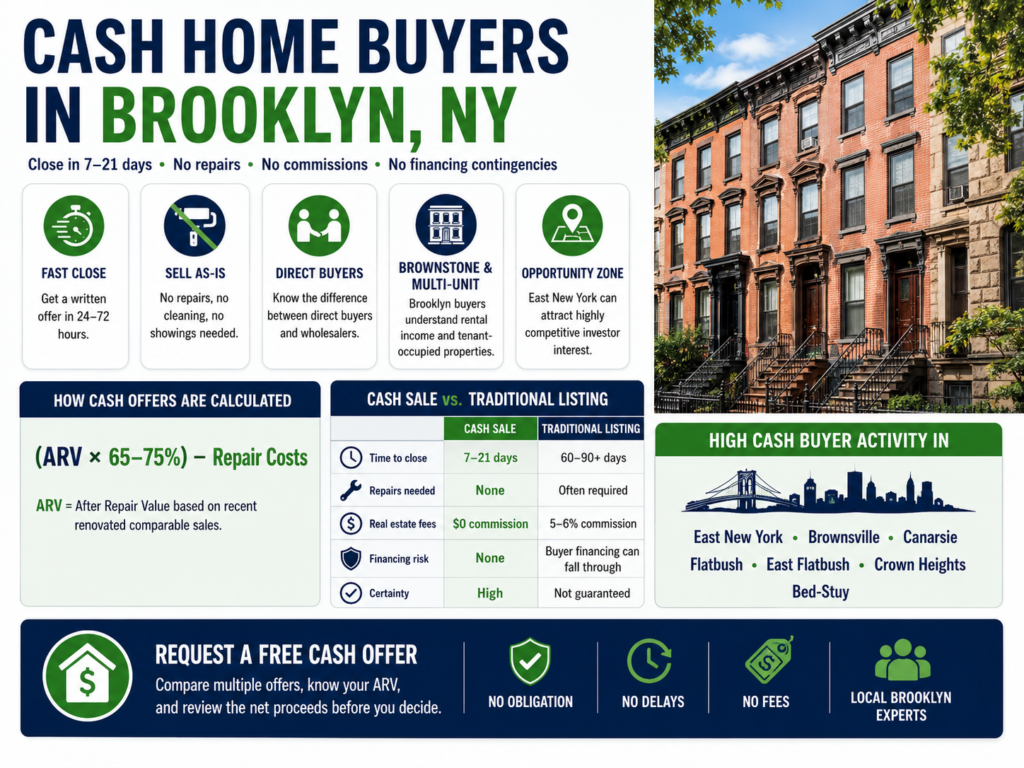
Cash home buyers in Brooklyn can close your sale in 7 to 21 days — no repairs, no commissions, no financing contingencies. But Brooklyn’s cash buyer market has characteristics that set it apart from Nassau, Suffolk, and even Queens: higher ARVs that push offer floors up significantly, a dense concentration of investor activity in East Brooklyn’s Opportunity Zone, and a brownstone market that requires buyers with specific multi-unit expertise.
This guide explains exactly who cash buyers are in Brooklyn, how they calculate their offers using the ARV formula, what the East New York Opportunity Zone means for sellers, how to verify a buyer is legitimate, and how to negotiate effectively.
Table of Contents
- Who Are Cash Home Buyers in Brooklyn?
- How Cash Buyers Calculate Their Offers: The ARV Formula
- The East New York Opportunity Zone Advantage
- What Cash Buyers Look For in Brooklyn Properties
- How to Verify a Cash Buyer Is Legitimate
- How to Get the Best Cash Offer for Your Brooklyn Home
- Cash Buyer Activity by Brooklyn Neighborhood
- The Cash Offer Process: Step by Step
- Frequently Asked Questions
Who Are Cash Home Buyers in Brooklyn?
Individual Real Estate Investors
Local investors who purchase properties with their own capital, renovate them, and either resell (fix-and-flip) or hold as rentals. These buyers are typically deeply familiar with specific Brooklyn submarkets — East New York, Brownsville, Flatbush, Canarsie, Crown Heights, Bed-Stuy — and can move quickly. They tend to be more flexible on terms and closing dates than larger companies because they are making decisions independently.
Direct Home-Buying Companies
Companies that purchase homes directly from sellers as a core business model. These operate with standardized processes: online inquiry, property evaluation, written offer within 24 to 72 hours, and a set closing timeline. They offer consistency and speed but typically less flexibility on price than individual investors.
Brownstone and Multi-Unit Specialists
A Brooklyn-specific category: investors who specialize exclusively in 2 to 4 unit brownstones and row houses. These buyers understand NYC tenant law, occupied-unit purchasing, cap rate valuation, and the historic preservation considerations that apply to many Brooklyn brownstones. For owners of multi-unit properties, working with a buyer who has this specific expertise is critical — a generalist cash buyer may undervalue the income-producing potential of the property.
Opportunity Zone Investors
East New York’s federal Opportunity Zone designation has attracted a specific category of institutional and individual investors who receive significant tax benefits for deploying capital in the zone. These buyers are motivated by tax incentives in addition to property fundamentals — which can result in more competitive offers on East New York properties than the standard ARV formula would suggest.
Wholesalers — Know the Difference
Wholesalers are not cash buyers — they are intermediaries who put your property under contract and then sell that contract to an actual buyer. Wholesalers are active in Brooklyn’s East New York, Brownsville, and Flatbush markets. The problem: a wholesaler’s “offer” is not a funded offer. They need to find an end buyer before closing, which means deals fall through more often. Always confirm whether you are dealing with a direct buyer or a wholesaler before signing anything.
Wholesaler warning: If a buyer asks you to sign an “assignment clause” in the purchase contract, you are likely dealing with a wholesaler, not a direct cash buyer. A direct buyer does not need to assign the contract to a third party. Always ask: “Are you the actual buyer, or will this contract be assigned to someone else?”
How Cash Buyers Calculate Their Offers: The ARV Formula
Every serious cash buyer in Brooklyn uses a version of the same formula. Understanding it before receiving any offer is the most useful preparation you can do.
Maximum Offer = (ARV × 65–75%) − Estimated Repair Costs
ARV = After Repair Value — what the home will be worth once fully renovated, based on recent comparable sales of renovated properties in your specific Brooklyn neighborhood.
Breaking Down Each Variable
ARV (After Repair Value): What comparable renovated homes in your Brooklyn neighborhood have sold for in the last 90 days. In Brooklyn’s diverse market, ARV varies dramatically by neighborhood — a renovated home in East New York might achieve $750,000 while the same renovation in Park Slope achieves $2 million. Research recent sales on StreetEasy for your specific block before any buyer conversation.
The 65–75% multiplier: The margin the buyer needs to cover holding costs, transaction costs on resale, and profit. Most Brooklyn investors use 68 to 72% as their standard multiplier. Properties in Opportunity Zone areas like East New York may see slightly higher multipliers because investors have additional tax incentives offsetting their return requirements.
Estimated repair costs: The buyer’s projection of what it costs to bring the property to market-ready condition. This is the most negotiable variable in the formula.
A Real Brooklyn Example
| Variable | East New York Example | Crown Heights Example |
|---|---|---|
| ARV (renovated comps) | $680,000 | $1,050,000 |
| × 70% multiplier | $476,000 | $735,000 |
| − Estimated repair costs | −$65,000 | −$80,000 |
| = Maximum offer | $411,000 | $655,000 |
Brooklyn’s high ARVs work in your favor. A $20,000 reduction in the repair estimate translates to a $14,000 higher offer at 70% formula. If a buyer’s repair estimate seems inflated, request a breakdown and counter with contractor quotes. Repair estimates are the most negotiable variable — always question them.
How Brownstones Are Valued Differently
For multi-unit brownstones with established rental income, experienced buyers use a second valuation method alongside the ARV formula: income-based cap rate valuation. A brownstone generating $7,000 per month in gross rent across three units has a very different value profile than a vacant single-family home at the same price point. If your brownstone has stable, at-market tenants, document the rental income before contacting any buyer — it directly supports a higher offer.
The East New York Opportunity Zone Advantage
East New York’s federal Opportunity Zone designation is one of the most significant factors affecting cash buyer behavior in Brooklyn’s eastern neighborhoods. Understanding it helps you negotiate more effectively if your property is in this area.
What the Opportunity Zone Means for Sellers
Investors who deploy capital in Opportunity Zones receive significant federal tax benefits — including deferral and potential elimination of capital gains taxes on their investment returns. This gives Opportunity Zone investors a lower effective cost of capital than investors in non-designated areas, which theoretically allows them to make more competitive offers.
East New York’s Opportunity Zone status, combined with major MTA transit improvements and the neighborhood’s 9.2% year-over-year appreciation in 2026, has made it one of the most active cash buyer markets in all of Brooklyn. Sellers in East New York have more buyer competition than in many other Brooklyn neighborhoods — which means more leverage to negotiate.
East New York ZIP codes in the Opportunity Zone: 11207 and 11208 are within the designated zone. If your property is in these ZIP codes, contact multiple buyers simultaneously — the competition among Opportunity Zone investors is real and produces better offers.
What Cash Buyers Look For in Brooklyn Properties
Structural and Mechanical Condition
Foundation integrity, roof condition, boiler or HVAC systems, electrical panel, and plumbing are assessed first. Brooklyn’s pre-war housing stock — row houses and brownstones built in the 1900s through 1940s — frequently has aging boilers, knob-and-tube wiring remnants, and galvanized plumbing. These are the highest-cost repairs and the ones that most significantly affect the offer price.
DOB and HPD Violations
Cash buyers specifically check the NYC Department of Buildings (DOB) and Housing Preservation and Development (HPD) violation databases before making an offer. Open violations are factored into the repair estimate and reduce the offer accordingly. Knowing your violation status before contacting buyers — by checking nyc.gov/buildings and nyc.gov/hpd — allows you to set accurate expectations and avoid surprises.
Tenant Occupancy Status
For multi-unit properties, tenant status significantly affects the offer. Market-rate tenants at or near current market rent support a higher income-based valuation. Below-market long-term tenants reduce the income value. Vacant units are simpler for fix-and-flip buyers but may reduce the income-based offer. Know your tenant situation — lease terms, current rent vs. market rent — before any buyer conversation.
Neighborhood Trajectory
Brooklyn buyers are acutely aware of neighborhood appreciation trajectories. East New York, Canarsie, and East Flatbush are appreciating rapidly — buyers price this upside into their ARV projections. Established neighborhoods like Park Slope and Carroll Gardens have high ARVs but less appreciation upside, making renovation economics different.
How to Verify a Cash Buyer Is Legitimate in Brooklyn
Signs of a Legitimate Cash Buyer
- Provides a written offer with transparent terms within 24 to 72 hours
- Supplies proof of funds without hesitation — a bank statement or proof-of-funds letter
- Has a verifiable track record of closed transactions specifically in Brooklyn — ask for addresses of recent closes
- Charges no upfront fees before closing
- Gives you 24 to 48 hours to review the offer without pressure
- Explains their offer clearly — ARV used, repair estimate breakdown, how they arrived at the price
- Does not include an assignment clause in the contract
Red Flags Specific to Brooklyn
- Pressure to sign immediately — particularly common in East New York and Brownsville where wholesaler activity is highest
- No proof of funds — a legitimate buyer has capital ready before making an offer
- Assignment clause in the contract — signals a wholesaler, not a direct buyer
- Offer that seems unrealistically high — some operators use inflated initial offers to lock in a contract, then renegotiate aggressively before closing
- No verifiable Brooklyn track record — national brand recognition is not a substitute for demonstrated local closes
How to Get the Best Cash Offer for Your Brooklyn Home
Get Multiple Offers and Create Competition
Contact three to five verified cash buyers simultaneously and request offers at the same time. When buyers know they are competing — particularly in high-demand East Brooklyn neighborhoods — they tighten their margins. Even a $10,000 to $25,000 improvement in offer price results from the simple act of requesting multiple offers rather than accepting the first one that arrives.
Research Your Own ARV on StreetEasy
Look up recent sales of renovated comparable homes on your specific block on StreetEasy — Brooklyn’s most accurate real-time sales database. If a buyer presents an ARV that is $50,000 below what comparable renovated homes have actually sold for recently, you can counter with specific comparable sales data. The ARV is set by the market, not by the buyer.
Document Rental Income for Multi-Unit Properties
If your brownstone or multi-family has rental income, gather rent rolls, lease agreements, and bank statements showing consistent rent receipt before contacting buyers. Income documentation directly supports a higher income-based valuation — sometimes producing a higher offer than the straight ARV formula would generate.
Confirm NYC Transfer Tax Coverage in Writing
Many Brooklyn cash buyers cover the NYC Transfer Tax (1% or 1.425%) as part of their offer structure. On an $850,000 property, this represents $12,113 in savings. Always confirm in writing exactly which closing costs are covered before accepting any offer — and use uncovered costs as a negotiation point if needed.
Cash Buyer Activity by Brooklyn Neighborhood
| Neighborhood | Cash Buyer Activity | Typical ARV | Key Notes |
|---|---|---|---|
| East New York (11207, 11208) | Very High | $550,000–$750,000 | Opportunity Zone — most competitive cash buyer market in Brooklyn |
| Brownsville | Very High | $500,000–$680,000 | Significant distressed inventory, active investor pipeline |
| Canarsie | High | $650,000–$820,000 | Rapidly appreciating; waterfront proximity premium |
| East Flatbush / Flatbush | High | $650,000–$880,000 | Caribbean community buyer pool; strong two-family demand |
| Crown Heights | High | $800,000–$1.1M | Brownstone market; gentrification premium established |
| Bed-Stuy | High | $850,000–$1.3M | Brownstone buyers; strong appreciation ongoing |
| Bushwick | Moderate | $700,000–$1.0M | Mixed buyer profile; appreciation steady |
| Bay Ridge | Moderate | $750,000–$950,000 | Family market; less distressed inventory |
| Park Slope / Carroll Gardens | Lower | $1.5M–$3M+ | Premium market; retail buyers dominate; less cash buyer activity |
The Cash Offer Process: Step by Step
| Stage | What Happens | Timeframe |
|---|---|---|
| Initial inquiry | Submit property details — address, condition, timeline, tenant status | 15 minutes |
| Property review | Buyer evaluates address, condition, comps, ARV, DOB/HPD violations | 24–48 hours |
| Written offer | Buyer presents offer with price, terms, closing cost coverage, timeline | 24–72 hours after inquiry |
| Review and negotiation | Review terms, question repair estimates, negotiate on price and costs | 24–48 hours |
| Contract signing | Attorney reviews and signs purchase agreement — no assignment clause | 1–2 days |
| Title work | DOB/HPD violations, tax liens, ownership history verified by title company | 5–14 days |
| Closing | Funds transfer, deed records at Kings County, sale complete | 7–21 days total |
How do cash home buyers determine what my Brooklyn house is worth?
They use the ARV formula: After Repair Value multiplied by 65 to 75 percent, minus estimated repair costs. The ARV is based on recent comparable sales of renovated homes in your specific Brooklyn neighborhood — researched on StreetEasy and MLS data. For multi-unit brownstones, buyers also calculate income-based value using cap rates, which can sometimes produce a higher offer than the ARV formula alone. Knowing your own ARV and rental income figures before any conversation is the best preparation.
Does the East New York Opportunity Zone affect what cash buyers will pay?
Yes, in some cases. Opportunity Zone investors receive federal tax benefits that effectively reduce their cost of capital, which can allow them to make marginally more competitive offers than standard investors. East New York’s combination of Opportunity Zone status, 9.2% year-over-year appreciation, and high pre-foreclosure activity makes it one of the most active cash buyer markets in all of Brooklyn. If your property is in ZIP codes 11207 or 11208, get multiple offers simultaneously to leverage this competition.
Can a cash buyer purchase an occupied Brooklyn brownstone?
Yes. Cash buyers who specialize in Brooklyn multi-unit properties purchase occupied brownstones routinely — with tenants in place, under existing lease terms. The buyer assumes the landlord role at closing. NYC tenant protection laws remain in force after the sale, but that is the buyer’s responsibility to manage going forward. You receive your proceeds and have no further obligation to the tenants.
How do I know if a Brooklyn cash buyer is a wholesaler?
Ask directly: “Are you the actual buyer, or will this contract be assigned to someone else?” A direct buyer will say they are the buyer. A wholesaler will hedge or acknowledge the assignment. Also check the purchase contract for an assignment clause — language allowing the buyer to transfer the contract to a third party. If you see an assignment clause, you are dealing with a wholesaler, not a direct cash buyer. Direct buyers do not need assignment provisions.
Do cash buyers pay market value for Brooklyn homes?
No. Cash offers are typically 80 to 90 percent of market value. The discount reflects the buyer’s repair costs, holding costs, and profit margin. However, once you subtract agent commissions (5–6%), NYC Transfer Tax (1.425%), NY State Transfer Tax (0.4%), repair investments, and carrying costs from a traditional sale scenario, the net proceeds gap between a cash offer and a traditional listing is frequently $20,000 to $40,000 — sometimes less. Always compare net proceeds, not headline prices.
An informed seller negotiates better. Now that you understand how Brooklyn cash buyers calculate their offers, what the East New York Opportunity Zone means for your leverage, and how to verify a buyer is legitimate — you are in a stronger position than most homeowners who contact a buyer cold. Request multiple offers, know your ARV, and compare net proceeds before committing to anything.
Get a Free Cash Offer →