
Behind on Your Mortgage in Nassau County? Here Are Your Options

⚠ If you are already in foreclosure or have received a summons from your lender, time is the most critical factor. Read Section 2 (Foreclosure Timeline) first, then Section 3 (Can You Sell Before Foreclosure) before taking any other action.
Missing mortgage payments in Nassau County does not automatically mean losing your home — but it does start a clock. New York is a judicial foreclosure state, which means lenders must go through the court system to foreclose. That process takes time — often 12 to 24 months or longer — and it gives homeowners more options than many realize.
This guide explains what happens at each stage after missing payments, the specific foreclosure timeline under New York law, whether you can still sell the property before foreclosure completes, and how to decide between a loan modification and selling.
Legal note: This guide provides general information about New York foreclosure law and mortgage options. It is not legal advice. If you are facing foreclosure, consult a HUD-approved housing counselor and a New York foreclosure attorney before making any decisions.
1. What Happens After Missing Mortgage Payments in Nassau County
The sequence of events after missing payments is more structured than most homeowners realize. Each stage triggers specific lender actions and opens or closes specific options.
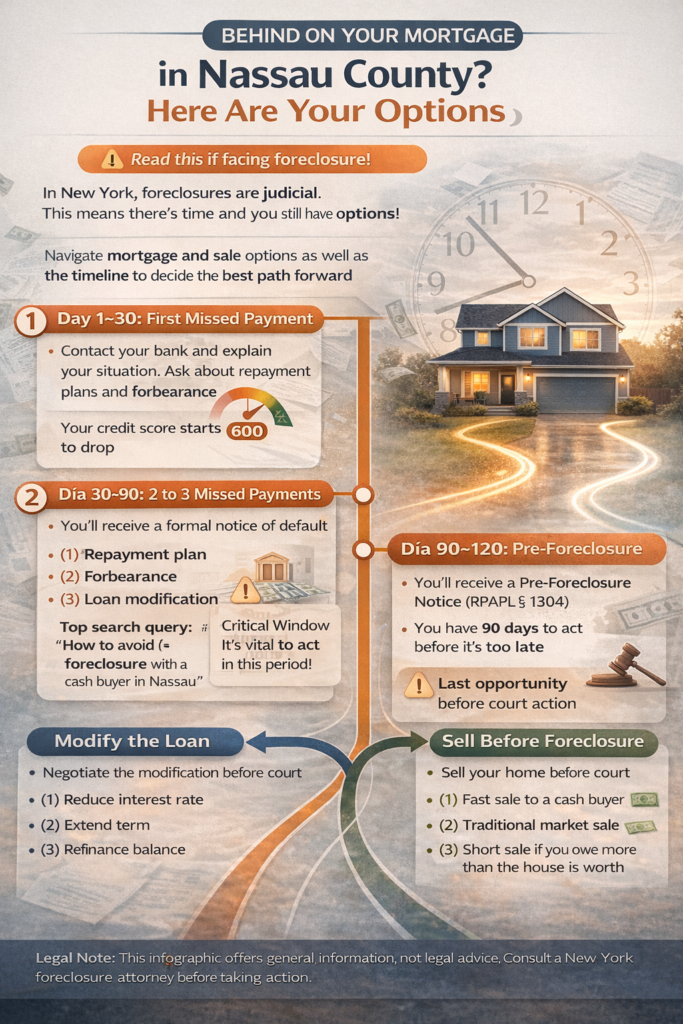
Day 1 to 30: First Missed Payment
Your loan is technically in default the day a payment is missed, but most lenders do not take formal action after a single missed payment. You will receive a call or letter from your lender’s loss mitigation department. Your credit score will begin to show the impact of the missed payment — typically a 60 to 110 point drop depending on your prior credit profile.
What to do: Contact your lender immediately. Do not avoid their calls. Explain your situation — job loss, medical emergency, temporary hardship — and ask about forbearance or a short-term repayment plan. Lenders are generally more cooperative at this stage than at any later point.
Day 30 to 90: 2 to 3 Missed Payments
After 30 to 60 days of non-payment, your loan servicer will escalate collection activity. You will receive formal written notice of default. Your account may be transferred to a loss mitigation or foreclosure department. Credit reporting continues, compounding the damage.
At this stage, lenders typically offer loss mitigation options: forbearance agreements (temporary pause or reduction of payments), repayment plans (catch up over time), or loan modification applications. These options remain available and should be actively pursued.
Critical window: Days 30 to 90 is the most important window for resolving a mortgage default without foreclosure. Homeowners who engage their lender at this stage have the highest success rate with loan modifications and repayment plans. Homeowners who avoid contact until the situation escalates have significantly fewer options.
Day 90 to 120: Notice of Default and Pre-Foreclosure
After 90 to 120 days of non-payment, most lenders issue a formal Notice of Default (NOD) — or in New York, initiate the pre-foreclosure process by sending a 90-day pre-foreclosure notice as required by New York RPAPL § 1304. This notice must be sent by first-class and certified mail and must include specific language required by New York law, along with a list of at least five HUD-approved housing counseling agencies.
The 90-day notice period begins a mandatory waiting period during which the lender cannot file a foreclosure action. This is a critical window for homeowners — use it.
After Day 120: Foreclosure Action Filed
Once the 90-day notice period expires without resolution, the lender can file a foreclosure action in Nassau County Supreme Court. New York is a judicial foreclosure state — meaning every foreclosure must go through the courts, which is why New York foreclosures take significantly longer than non-judicial states. From filing to final judgment, the process typically takes 12 to 24 months in Nassau County, sometimes longer if the homeowner contests the action.
2. The New York Foreclosure Timeline in Nassau County
Understanding the specific legal stages of a New York judicial foreclosure tells you exactly how much time you have at each point — and which options remain available.
| Stage | Trigger | Typical Timeline | Options Still Available |
| Missed payments begin | Day 1 | Day 1–90 | All options: repayment plan, forbearance, modification, sale |
| 90-day pre-foreclosure notice (RPAPL § 1304) | Day 90–120 | 90-day mandatory wait | All options: modification, reinstatement, sale |
| Foreclosure summons and complaint filed | After 90-day notice expires | Filed in Nassau County Supreme Court | Sale, loan modification, bankruptcy, legal defense |
| Mandatory settlement conference (RPAPL § 3408) | After filing | 90–180 days post-filing | Loan modification actively negotiated here; sale still possible |
| Note of issue / trial ready | After settlement conference fails | 6–12 months post-filing | Sale still possible; legal defense narrowing |
| Judgment of foreclosure and sale | Court judgment | 12–24 months post-filing | Redemption, bankruptcy stay, or sale before auction |
| Foreclosure auction | After judgment | Scheduled by referee | Last opportunity: sale before auction date |
| Post-auction / eviction | After auction | 60–120 days post-auction | Very limited; consult attorney immediately |
New York’s Mandatory Settlement Conference
One of New York State’s most important homeowner protections is the mandatory settlement conference required under RPAPL § 3408. After a foreclosure action is filed, the case is automatically referred to a settlement conference in Nassau County Supreme Court. Both the lender and the homeowner must appear — or be represented — and negotiate in good faith.
The settlement conference process can last 6 to 18 months, during which foreclosure proceedings are effectively paused. This is where loan modifications are most commonly negotiated and approved. A homeowner with an attorney at this stage has significantly better outcomes than one who appears without representation.
Key resource: Nassau County homeowners facing foreclosure can contact Nassau County Legal Services (516-292-8100) or the New York State Homeowner Protection Program (HOPP) for free legal representation at settlement conferences. These services exist specifically for this situation.
How Long Does Foreclosure Actually Take in Nassau County?
New York consistently has one of the longest foreclosure timelines in the country. In Nassau County, the average time from first missed payment to completed foreclosure is 24 to 36 months — and contested foreclosures can take significantly longer. This extended timeline is both a protection for homeowners and a reason why acting early produces the best outcomes.
| Scenario | Estimated Total Timeline |
| Uncontested foreclosure, cooperative homeowner | 18 to 24 months from first missed payment |
| Contested foreclosure with active legal defense | 30 to 48+ months |
| Homeowner engages at settlement conference | 24 to 36 months (with potential modification outcome) |
| Homeowner ignores all notices and filings | 18 to 30 months (faster than contested, still substantial) |
⚠ Having 24 months before a potential auction does not mean you have 24 months to decide. Every month of delay reduces your equity (through accruing interest, fees, and penalties), narrows your options, and increases lender legal costs that can be added to your debt.
3. Can You Sell Before Foreclosure in Nassau County?
Yes — in most cases, and this is one of the most important things homeowners in this situation need to understand. A pre-foreclosure sale allows you to sell the property before the foreclosure completes, pay off the outstanding mortgage balance from the proceeds, and potentially walk away with remaining equity instead of losing everything at auction.
How a Pre-Foreclosure Sale Works
As long as you still have legal title to the property — meaning the foreclosure auction has not yet occurred — you have the right to sell it. The proceeds from the sale go first to satisfy the outstanding mortgage balance, accrued interest, lender fees, and any other liens on the property. Whatever remains after those obligations are paid belongs to you.
Example: Nassau County home worth $480,000. Outstanding mortgage balance: $320,000. Accrued interest and lender fees: $18,000. Cash offer: $440,000. Net to homeowner: $440,000 − $320,000 − $18,000 = $102,000. Versus foreclosure auction outcome: potentially $300,000 to $350,000 at auction, after which lender takes the full amount and homeowner receives nothing if the balance exceeds auction proceeds.
What If You Owe More Than the Home Is Worth?
If your outstanding mortgage balance exceeds what the property would sell for — an underwater mortgage — a standard sale won’t cover the balance. In this case, you have two main options: a short sale or bankruptcy protection.
Short Sale: What It Is and When It Makes Sense
A short sale occurs when the lender agrees to accept less than the full mortgage balance as payment in full. The homeowner negotiates with the lender to approve the short payoff amount before the sale closes. Short sales in Nassau County typically take 3 to 6 months to complete because they require lender approval at each stage.
- Short sales require the lender’s written approval before closing
- The lender may forgive the deficiency (the difference between the sale price and the loan balance) or may seek a deficiency judgment
- New York has specific protections around deficiency judgments — consult an attorney before agreeing to any short sale terms
- A short sale is less damaging to your credit than a completed foreclosure, but more damaging than a standard sale
Legal note: New York’s Anti-Deficiency Statute (RPAPL § 1371) limits lenders’ ability to pursue deficiency judgments after foreclosure in some circumstances. A short sale agreement may contain different terms. Always have an attorney review any short sale agreement before signing.
Why Cash Buyers Are the Best Option for Pre-Foreclosure Sales
Time is the critical constraint in a pre-foreclosure sale. A financed buyer needs 30 to 45 days to close after an accepted offer — and their deal can still fall through if financing is denied. A cash buyer closes in 10 to 21 days with near-certainty. In a pre-foreclosure situation where the clock is running on lender fees and court timelines, that difference matters enormously.
Cash buyers who specialize in pre-foreclosure transactions also understand the payoff demand process — requesting the official payoff amount from the lender, coordinating with the foreclosure attorney, and ensuring the correct amounts are wired at closing. This experience matters when the transaction has to go exactly right.
What Happens to the Foreclosure Case When You Sell?
When the sale closes and the mortgage is paid off in full from the proceeds, the foreclosure case is dismissed. The lender files a discontinuance with Nassau County Supreme Court. Your title transfers clean to the buyer. The foreclosure does not appear as a completed foreclosure on your credit — it appears as a paid-off mortgage, which is significantly less damaging.
4. Loan Modification vs. Selling: How to Decide
This is the core decision for many Nassau County homeowners facing mortgage default. Both paths can work — but they work for different situations. Here is the honest comparison.
What a Loan Modification Actually Does
A loan modification permanently changes the terms of your mortgage to make the monthly payment more affordable. Common modifications include: reducing the interest rate, extending the loan term (which lowers monthly payments but increases total interest paid), capitalizing arrears (adding missed payments to the loan balance), or a combination of these.
A loan modification does not reduce your principal balance in most cases — it restructures the payment. If your home is worth less than you owe, a modification keeps you in the home but does not resolve the negative equity.
The Math: Loan Modification vs. Selling
| Factor | Loan Modification | Selling (Cash Buyer) |
| Stay in the home? | Yes | No — you must find new housing |
| Resolves negative equity? | No — restructures payment only | Only if sale price covers the balance |
| Credit impact | Moderate — modification noted on record | Less damage than foreclosure; standard if paid in full |
| Monthly payment after action | Reduced — but still present | Eliminated |
| Equity preserved? | Depends on future appreciation | Cash in hand now (if equity exists) |
| Timeline to resolution | 3–6 months for approval and implementation | 10–21 days to close |
| Risk of re-default | Present — if hardship continues | None — obligation eliminated |
| Recommended when… | Hardship is temporary; you want to stay in the home; equity is positive or neutral | Hardship is ongoing; you need to move; equity exists and you want to capture it |
When Loan Modification Is the Right Choice
A loan modification makes sense when your financial hardship is genuinely temporary — a job loss you’re recovering from, a medical expense that’s been resolved, or a short-term income disruption. If you want to stay in the home, have positive equity, and have a realistic path to resuming regular payments within 12 to 18 months, pursuing a modification through the mandatory settlement conference process is worth it.
- You want to remain in the home long-term
- Your hardship has a defined end (job found, medical recovery, etc.)
- You have positive equity you’d rather preserve through appreciation than capture now
- A reduced monthly payment is all you need to stabilize the situation
When Selling Is the Better Decision
Selling — even in a pre-foreclosure situation — is often the cleaner financial decision when the hardship is ongoing or the home no longer fits your situation. If you’re relocating, if the home is too large or too expensive, if you’re carrying negative equity in a market that’s unlikely to recover the gap, or if you simply want to eliminate the monthly obligation and start fresh, a sale achieves that definitively.
- Your financial hardship is ongoing with no clear resolution date
- You have equity in the property you want to capture as cash
- Relocating or downsizing is part of the solution
- A modified payment would still be a strain
- You want a definitive end to the obligation rather than restructured terms
The honest question: Can you genuinely afford the modified payment for the next 5 to 10 years? If the answer is uncertain, a modification may delay the same decision you’re facing now by 12 to 24 months — with more accrued interest and fees reducing your eventual equity.
Can You Pursue Both Simultaneously?
Yes. You can apply for a loan modification and simultaneously list the property or request a cash offer. If the modification is approved and the terms work for you, you keep the home. If the modification is denied or the terms aren’t workable, you have a sale ready to close. In a pre-foreclosure situation where time matters, keeping both paths open in parallel is the most prudent approach.
5. Other Options When Behind on Your Mortgage in Nassau County
Forbearance Agreement
A temporary pause or reduction of mortgage payments, typically 3 to 12 months, granted by the lender based on documented hardship. Forbearance does not forgive the missed payments — they must be repaid, either in a lump sum at the end of the forbearance period, through a repayment plan, or through a loan modification. Forbearance buys time; it does not resolve the underlying debt.
Reinstatement
Paying the full amount of all missed payments, interest, and fees in a single lump sum to bring the loan current. This is the simplest resolution if you have access to the capital — perhaps from a family member, a retirement account, or sale of another asset. In Nassau County, reinstatement is possible up until the foreclosure sale date, and even after a judgment has been entered, in some circumstances.
Deed in Lieu of Foreclosure
Voluntarily transferring the deed to your lender in exchange for release from the mortgage obligation. A deed in lieu avoids the formal foreclosure process but requires the lender’s agreement. Lenders are most likely to accept a deed in lieu when the property has no junior liens and the homeowner has no other practical options. The credit impact is similar to a foreclosure.
Bankruptcy (Chapter 7 or Chapter 13)
Filing for bankruptcy triggers an automatic stay that immediately halts all foreclosure proceedings — including a scheduled auction. Chapter 13 bankruptcy allows homeowners to propose a repayment plan that includes catching up on mortgage arrears over 3 to 5 years while keeping the home. Chapter 7 can discharge other debts to free up cash for mortgage payments but does not eliminate the mortgage itself.
Bankruptcy is a significant legal step with long-term credit and financial implications. It is sometimes the right tool — particularly for homeowners with substantial unsecured debt alongside the mortgage default — but should only be pursued after consulting a bankruptcy attorney.
Legal note: Bankruptcy law is complex and the interaction between bankruptcy and foreclosure in New York has specific rules. Never file for bankruptcy solely to delay foreclosure without understanding the full implications. Consult a bankruptcy attorney before taking this step.
HUD-Approved Housing Counseling — Free Resource
HUD-approved housing counselors provide free, confidential counseling to homeowners facing foreclosure. They can help you understand your options, prepare for a loan modification application, represent you in negotiations with your lender, and connect you with legal resources. In Nassau County, this is available through:
- NHS of Long Island (Neighborhood Housing Services): nhsli.org
- Long Island Housing Partnership: lihp.org
- National hotline: 1-800-569-4287 (HUD Housing Counselor Referral Line)
- New York State Homeowner Protection Program (HOPP): 1-855-HOME-456
6. Frequently Asked Questions About Mortgage Default in Nassau County
How many mortgage payments can I miss before foreclosure in New York?
Lenders typically begin the formal pre-foreclosure process after 90 to 120 days (3 to 4 missed payments). New York law then requires a mandatory 90-day notice before the lender can file a foreclosure action. So the earliest a foreclosure can be filed is approximately 6 months after the first missed payment — and the process itself takes 12 to 24 months after filing. Total minimum from first missed payment to completed foreclosure: approximately 18 to 30 months.
Can I sell my house if I’m behind on mortgage payments in Nassau County?
Yes, as long as you still have legal title. A pre-foreclosure sale allows you to sell the property, pay off the outstanding mortgage balance from the proceeds, and keep any remaining equity. If you owe more than the home is worth, a short sale requires lender approval. A cash buyer can close in 10 to 21 days — fast enough to complete the sale well before any scheduled auction in most cases.
What is the foreclosure process in New York State?
New York uses a judicial foreclosure process: the lender must file a lawsuit in Nassau County Supreme Court, serve the homeowner, go through a mandatory settlement conference, and obtain a court judgment before scheduling a foreclosure auction. This process takes 18 to 36 months on average, making New York one of the states with the longest foreclosure timelines. The length of the process gives homeowners more time to explore options than in non-judicial states.
Will foreclosure show up on my credit report?
A completed foreclosure stays on your credit report for 7 years from the date of the first missed payment and has a severe negative impact. A pre-foreclosure sale that pays off the mortgage in full shows as a paid mortgage — significantly less damaging. A short sale typically shows as “settled for less than the full amount” or similar notation, which is less damaging than a completed foreclosure but more damaging than a standard payoff.
Can a cash buyer close fast enough to stop foreclosure in Nassau County?
In most pre-foreclosure situations, yes. A verified cash buyer can close in 10 to 21 days from accepted offer — which is faster than any stage of the foreclosure timeline except in the final days before a scheduled auction. If you are past the judgment stage and an auction has been scheduled, contact a foreclosure attorney and a cash buyer simultaneously to determine whether the timeline allows a sale.
What is a loan modification and how do I apply?
A loan modification permanently changes your mortgage terms — typically by reducing the interest rate or extending the loan term — to make payments more affordable. Apply directly through your loan servicer’s loss mitigation department. Required documents typically include proof of income, bank statements, tax returns, a hardship letter, and a completed Request for Mortgage Assistance (RMA) form. The process takes 3 to 6 months. In a New York foreclosure, modifications are most commonly negotiated through the mandatory settlement conference process.