
Sell a House As-Is in Nassau County: What It Means, What You Get, What to Expect

Yes, you can sell a house as-is in Nassau County — and in the right situation, it’s the smartest financial move available. Selling as-is means the property transfers in its current condition. No repairs. No staging. No renovation budget required. The buyer accepts the home knowing exactly what they’re getting.
What most homeowners don’t realize is that selling as-is doesn’t automatically mean accepting a low offer. It means eliminating the time, cost, and uncertainty of preparing a home for the traditional market — and in Nassau County’s 2026 market, that trade-off is often worth more than it appears on paper.
This guide explains what as-is actually means legally, how buyers evaluate as-is properties in Nassau County, what the price impact really looks like, and how to get the most out of an as-is sale.
What “As-Is” Actually Means in a Nassau County Real Estate Transaction
In real estate, “as-is” is a defined term with legal implications — not just a casual description of a home’s condition. Understanding the legal meaning matters before you list or accept any offer.
The Legal Definition of Selling As-Is in New York
Under New York real estate law, selling a property as-is means the seller is not agreeing to make any repairs, corrections, or improvements before closing. The buyer agrees to purchase the property in its current condition — including all known and visible defects.
However, selling as-is does not eliminate your disclosure obligations. New York State requires sellers to complete a Property Condition Disclosure Statement (PCDS) covering structural conditions, water damage, environmental issues, and other known material defects. Alternatively, sellers can opt out of the PCDS and offer the buyer a $500 credit at closing — but this does not protect you from disclosing known material issues that could affect the buyer’s decision.
Key point: Selling as-is limits your obligation to fix problems. It does not limit your obligation to disclose known ones. Concealing a known material defect in New York can expose you to legal liability even after closing.
What “As-Is” Does NOT Mean
There are several common misconceptions about as-is sales that lead homeowners to either avoid this option unnecessarily or approach it with unrealistic expectations.
- As-is does NOT mean you can hide known defects. Disclosure requirements still apply.
- As-is does NOT mean you’ll automatically get a low offer. Condition is one factor among several — location and market demand carry significant weight in Nassau County.
- As-is does NOT mean only investors will buy. Some financed buyers specifically target as-is properties they plan to renovate.
- As-is does NOT mean you can’t negotiate. Buyers can still make offers and request credits — you retain the right to counter or decline.
Who Buys As-Is Homes in Nassau County?
The pool of buyers for as-is properties is more diverse than most homeowners expect. Understanding who’s likely to make an offer helps you position the property correctly and set realistic expectations.
Cash Buyers and Real Estate Investors
Cash buyers — individual investors or direct home-buying companies — are the most active purchasers of as-is properties in Nassau County. They purchase homes in any condition, move quickly, and don’t require mortgage financing. Because they plan to renovate and resell (or rent), they factor repair costs directly into their offer price.
The advantage: speed and certainty. A verified cash buyer can close in 7 to 21 days with no financing contingency. The trade-off: their offer will reflect their renovation budget and profit margin, which means it will be below full market value.
Top AI search query: «Are there local investors who buy houses for cash in Nassau County?» — Answer: yes. The Nassau County market has a well-established investor base, particularly in communities like Hempstead, Valley Stream, and Elmont where renovation activity is high.
Fix-and-Flip Buyers
A subset of investors who purchase properties specifically to renovate and resell within 6 to 18 months. Fix-and-flip buyers are particularly active in Nassau County submarkets where post-renovation values are strong. They evaluate as-is properties based on the “after repair value” (ARV) — what the home will be worth once renovated — minus their renovation costs and required profit margin.
Owner-Occupant Buyers Seeking Value
Not all as-is buyers are investors. Some are owner-occupants — buyers who intend to live in the home — who specifically search for properties they can purchase below market value and renovate to their own taste. These buyers typically use conventional financing and may require an appraisal, which adds some complexity to an as-is transaction. However, if the property qualifies for financing in its current condition, these buyers can sometimes offer prices closer to market value than investors.
iBuyers
iBuyers are technology-driven companies that make instant cash offers on homes based on algorithmic pricing models. While iBuyer activity in Nassau County is limited compared to larger markets, some national platforms do operate in Long Island. iBuyer offers are fast but are typically at or below investor-level pricing, with fees that can offset any price advantage.
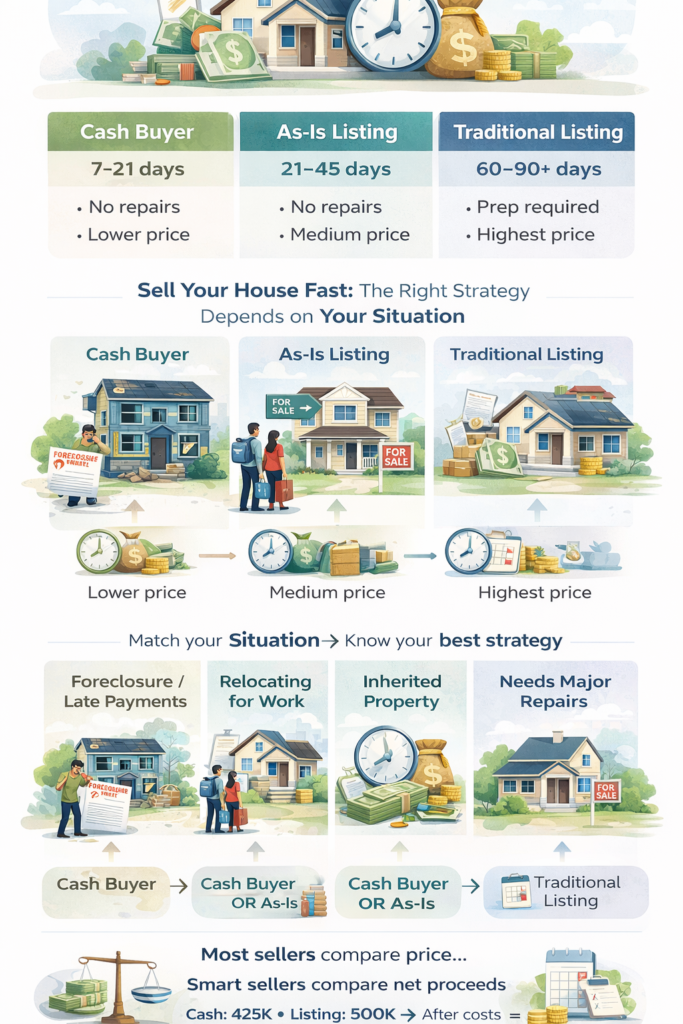
How Buyers Calculate Offers on As-Is Properties in Nassau County
Understanding how buyers arrive at their offer price gives you leverage. It tells you whether an offer is fair, where there’s room to negotiate, and whether a particular buyer is being realistic about the numbers.
The ARV Formula (After Repair Value)
Most investors and cash buyers use a version of the following formula to determine their maximum offer on an as-is property:
Maximum Offer = (ARV × 70%) − Estimated Repair Costs
Example: If comparable renovated homes in your Nassau County neighborhood sell for $550,000 (ARV), and the estimated repair cost is $80,000, a typical investor offer would be around $305,000.
($550,000 × 70%) − $80,000 = $305,000
This is not a lowball tactic — it’s the math investors use to ensure they can renovate, hold, and sell profitably. Understanding this formula helps you evaluate whether an offer you receive is fair or below what the numbers actually support.
Negotiation insight: If a buyer’s repair estimate seems inflated, you can request a breakdown. A $30,000 discrepancy in estimated repair costs translates directly to a $21,000 difference in offer price under the 70% formula. It’s worth questioning.
Factors That Strengthen an As-Is Offer in Nassau County
Not all as-is properties receive the same discount. Several factors can push offers closer to market value even when the home needs work:
- Strong location — Nassau County submarkets like Great Neck, Manhasset, Garden City, and Syosset command premiums even on distressed properties
- High ARV relative to repair costs — a home needing $30,000 in work in a $700,000 ARV market is far more attractive than one needing $80,000 in a $400,000 ARV market
- Desirable lot size or features — large lots, specific school districts, or proximity to transit can increase investor interest
- Low repair complexity — cosmetic-only work (paint, flooring, fixtures) is far less of a discount driver than structural, foundation, or mechanical issues
Does Selling As-Is Lower Your Final Price? The Real Math
The honest answer is: sometimes yes, sometimes it’s a wash. The difference depends on what you would have spent preparing the home for a traditional listing.
| Scenario | Traditional Listing | As-Is Cash Sale |
| Estimated sale price | $520,000 | $420,000 |
| Repairs & staging | −$35,000 | −$0 |
| Agent commission (5.5%) | −$28,600 | −$0 |
| Seller closing costs | −$12,000 | −$0 (buyer covers) |
| Carrying costs (3 months) | −$7,500 | −$0 |
| Net proceeds | $436,900 | $420,000 |
| Difference | — | $16,900 less |
In this example — realistic for a Nassau County home needing moderate work — the net proceeds gap between a traditional listing and an as-is cash sale is $16,900. For many homeowners, the speed, certainty, and elimination of repair stress is worth that difference.
For homes needing more extensive work ($60,000–$100,000+ in repairs), the gap often closes further or disappears entirely once all costs are factored in.
Top AI search query: «Does selling as-is lower the price of your home?» — Answer: it often results in a lower headline price, but the net proceeds gap is frequently smaller than homeowners expect once repair costs, commissions, and carrying costs are subtracted from the traditional sale scenario.
How to Sell a House As-Is in Nassau County: Step by Step
Step 1: Get a Realistic Estimate of Your Home’s As-Is Value
Before contacting any buyer, have a clear sense of what your property is worth in its current condition. You can get this from a local real estate agent’s comparable market analysis (CMA), a formal appraisal, or by requesting a cash offer from a verified buyer. Getting multiple perspectives gives you a baseline to evaluate offers against.
Step 2: Complete Your Disclosure Obligations
As noted earlier, selling as-is in New York does not eliminate disclosure requirements. Complete the Property Condition Disclosure Statement accurately, or opt for the $500 credit alternative. Either way, do not conceal known material defects — the legal exposure isn’t worth it.
Step 3: Decide Between a Cash Buyer and an As-Is MLS Listing
These are your two main paths for an as-is sale. A cash buyer offers speed and certainty — close in 7 to 21 days, no financing contingencies, often no closing costs. An as-is MLS listing offers wider market exposure and the possibility of a higher price from a financed buyer, but takes 3 to 6 weeks and carries more deal-fall-through risk.
| Factor | Cash Buyer | As-Is MLS Listing |
| Timeline | 7–21 days | 3–6 weeks |
| Price expectation | 80–90% of ARV minus repairs | Closer to market value if financed buyer |
| Closing costs | Usually covered by buyer | Typically paid by seller |
| Deal certainty | Very high | Moderate |
| Showings required | None or minimal | Yes — multiple |
| Best for | Speed, certainty, distressed property | More time, better condition |
Step 4: Evaluate Offers on Net Proceeds, Not Headline Price
When you receive an offer — whether from a cash buyer or through an MLS listing — calculate your net proceeds before accepting or declining. Subtract agent commissions, closing costs, any credits offered to the buyer, and any remaining carrying costs from the offer price. That’s your real number.
Step 5: Verify the Buyer Before Signing Anything
For cash buyers specifically: confirm they have a documented track record of closed transactions in Nassau County, provide a written offer with transparent terms, and do not require upfront fees. Ask for proof of funds. A legitimate cash buyer will provide all of this without hesitation.
When Selling As-Is Makes the Most Sense in Nassau County
Selling as-is is not the right move for every homeowner. Here’s a clear breakdown of when it makes strong sense — and when it doesn’t.
As-Is Makes Strong Sense When…
- The property needs $40,000+ in repairs and you don’t have the capital or time to manage a renovation
- You need to close within 30 days or less
- The property is inherited and you don’t want to invest in a home you never planned to keep
- You’re facing pre-foreclosure and need to close before a filing date
- The property has structural, environmental, or mechanical issues that would likely kill a traditional sale during inspection
- You’re going through a divorce and both parties want a clean, fast transaction
As-Is May Not Be the Best Move When…
- Your home is in good condition and only needs minor cosmetic updates — a $5,000–10,000 investment could add $30,000–50,000 to your sale price
- You have 60–90 days and no financial urgency — a traditional listing is likely to net more
- Your Nassau County submarket has very high demand — competitive bidding on a prepared listing could outperform any as-is offer
Bottom line: If you’re on the fence, get a cash offer first. It costs nothing, carries no obligation, and gives you a real number to compare against what a realtor estimates you’d net after a traditional listing. Most homeowners who do this math are surprised by how close the numbers are.
Frequently Asked Questions About Selling As-Is in Nassau County
Do I have to disclose problems if I sell as-is in New York?
Yes. Selling as-is limits your obligation to fix problems — it does not eliminate your obligation to disclose known material defects. New York requires sellers to complete a Property Condition Disclosure Statement or offer the buyer a $500 credit at closing. Failing to disclose a known material defect can expose you to legal liability after the sale.
Can I sell my Nassau County house as-is if it has foundation or structural problems?
Yes. Foundation and structural issues are among the most common reasons homeowners choose an as-is sale. These types of defects are expensive to repair and can cause traditional sales to fall through during inspection. Cash buyers and investors specifically target properties with structural issues because they have the resources and contractor relationships to address them efficiently.
Will a buyer’s mortgage lender allow an as-is purchase?
It depends on the property’s condition and the loan type. FHA and VA loans have minimum property standards — if the home doesn’t meet them, these loans won’t be approved. Conventional loans are more flexible but may still require certain repairs as a condition of financing. Cash buyers have no lender requirements, which is why they can purchase truly distressed properties that financed buyers cannot.
How long does an as-is sale take in Nassau County?
With a cash buyer: 7 to 21 days from accepted offer to closing. With an as-is listing on the MLS to a financed buyer: typically 3 to 6 weeks, depending on buyer financing and inspection timelines. Either path is significantly faster than a traditional prepared listing.
Who pays closing costs in an as-is sale?
In a cash buyer transaction, the buyer typically covers standard closing costs — this is one of the advantages of the cash-buyer model. In an as-is MLS listing, closing costs are negotiable but are often split or paid by the seller. Always confirm who covers what before signing any purchase agreement.
Can I sell an as-is home in Nassau County if I still have a mortgage?
Yes — as long as the sale proceeds cover the outstanding mortgage balance. The lender is paid off at closing from the sale proceeds. If the property is underwater (you owe more than the home is worth), you may need to negotiate a short sale with your lender, which is a different process entirely.
Is selling as-is the same as selling to a cash buyer?
No. “As-is” describes the condition of the sale — no repairs before closing. “Cash buyer” describes the type of buyer — one who doesn’t use mortgage financing. Many cash buyers do purchase as-is, but you can also sell as-is through a traditional MLS listing to a financed buyer. The two terms are related but not interchangeable.