
How to Sell a House During Divorce in Nassau County (2026)

Selling a house during divorce is one of the most financially significant decisions you’ll make in the process — and one of the most emotionally complicated. Two people who may not be agreeing on much need to agree on price, timing, agent, offers, and closing terms.
This guide covers what New York law actually requires when dividing marital property, what your options are when spouses disagree on selling, which selling method fits a divorce situation, and what the process looks like from accepted offer to closing.
Legal note: This guide provides general information about New York real estate and divorce law. It is not legal advice. Consult a New York divorce attorney before making any decisions about marital property.
How New York Law Treats the Marital Home in a Divorce
New York is an equitable distribution state — not a community property state. That distinction matters.
What Equitable Distribution Means in Practice
Equitable distribution does not automatically mean 50/50. It means the court divides marital assets in a way it considers fair, based on factors including the length of the marriage, each spouse’s income and earning potential, contributions to the marriage, and the needs of any children involved.
For most Nassau County divorces involving a shared home, the practical outcomes are:
| Outcome | What It Means |
|---|---|
| One spouse buys out the other | One party refinances in their name and pays the other their share of equity |
| Property is sold and proceeds split | Both parties agree or court orders a sale; proceeds divided per settlement |
| One spouse stays temporarily | Typically when minor children are involved; sale deferred until specific trigger |
| Court orders a forced sale | When parties can’t agree; judge orders sale and appoints a referee |
Is the House Marital Property?
In most Nassau County cases, yes — if it was purchased during the marriage, regardless of whose name is on the deed. Exceptions exist: a home owned before marriage and never refinanced or significantly improved with marital funds may have a separate property argument. A home received as an inheritance or gift — even during the marriage — may also qualify as separate property.
This distinction affects how much of the sale proceeds belong to each spouse. It’s a legal question your divorce attorney needs to answer before you agree to any sale terms.
What Happens When Both Spouses Agree to Sell
When both parties agree to sell the marital home, the process follows the same basic path as any Nassau County sale — with one added layer of coordination.
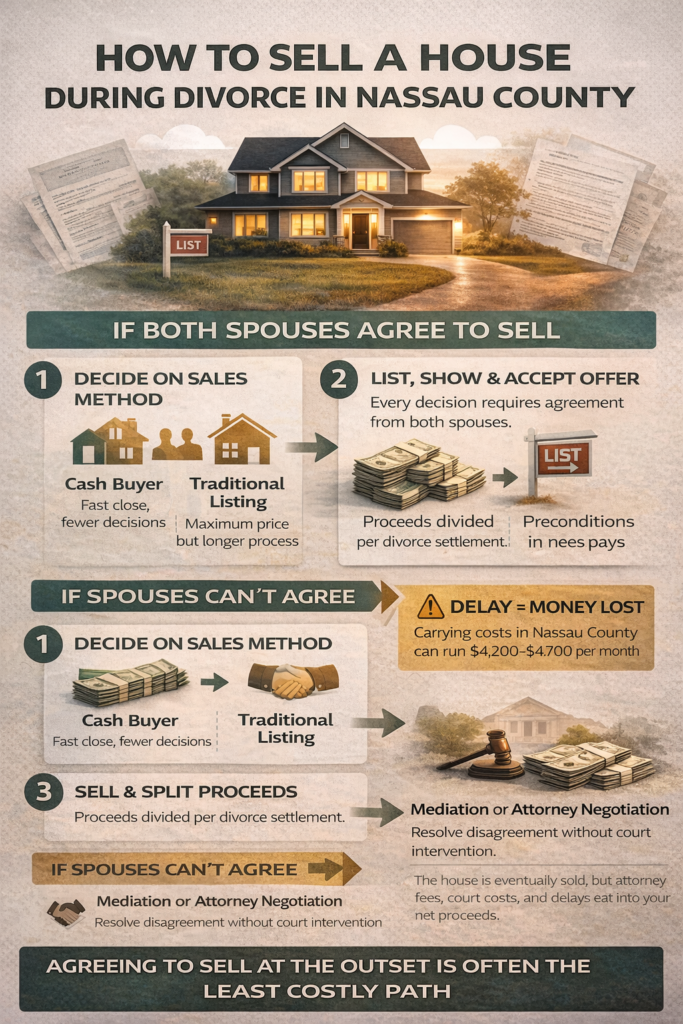
Every Decision Requires Agreement From Both Parties
Listing price, agent selection, showing schedules, offer acceptance, credits to buyers, and closing date — all of it requires both spouses to sign off. In a cooperative divorce, this works. In a contested one, every decision becomes a potential conflict.
This is the core reason why many divorce attorneys recommend the simplest possible sale path — not necessarily the one that maximizes proceeds, but the one that minimizes the number of decisions both parties have to make together.
Cash Buyer vs. Traditional Listing in a Divorce
| Factor | Cash Buyer | Traditional Listing |
|---|---|---|
| Decisions required | One: accept or decline the offer | Ongoing: price, showings, offers, repairs, credits |
| Timeline | 7–21 days | 60–90+ days |
| Repairs required | None | Typically yes |
| Deal fall-through risk | Very low | Moderate — financing can collapse |
| Emotional exposure | Minimal — clean and fast | Extended — months of coordination |
| Net proceeds | 80–90% of market value | Closer to full market value |
For divorces where both parties want it resolved quickly and cleanly, a cash sale often wins even at a lower headline price — because the net proceeds gap after commissions, repairs, and carrying costs is smaller than it appears, and the process requires one decision instead of dozens.
The Carrying Cost Reality
Every month the Nassau County marital home doesn’t close costs the estate — meaning both of you — real money. Nassau County property taxes average $1,250 to $1,500 per month. Add homeowners insurance, utilities, and mortgage payments if applicable, and carrying costs run $4,200 to $4,700 per month for a home with a mortgage.
A 90-day traditional listing process carries approximately $12,600 to $14,100 in costs that reduce the proceeds both parties eventually split. A 21-day cash close eliminates most of that.
What Happens When Spouses Disagree on Selling
This is where Nassau County divorces get complicated — and where understanding your legal options matters most.
Partition Action: The Legal Mechanism for Forced Sales
If one spouse wants to sell and the other refuses, any co-owner in New York can petition the court for a partition action— a legal proceeding that can force the sale of jointly held property and divide the proceeds.
Partition actions in Nassau County are handled in Supreme Court. They are:
- Expensive — attorney fees for both parties, plus court costs
- Time-consuming — typically 6 to 18 months to resolution
- Adversarial — the process tends to escalate conflict rather than resolve it
- Uncertain — the court controls the outcome, not either party
Partition is a last resort. In most cases, mediation or negotiation through divorce attorneys resolves the disagreement faster and at lower total cost than going to court.
Court-Ordered Sale
In a divorce proceeding — as opposed to a separate partition action — the divorce court itself can order the sale of the marital home as part of the divorce settlement. The judge may appoint a referee to manage the sale if the parties cannot cooperate. In that scenario, neither party has full control over the price, timing, or sale method.
If your divorce is heading toward a court-ordered sale, engaging a buyer and generating a written offer — even before the order is finalized — gives the court a concrete data point and can accelerate resolution.
Negotiated Settlement: The Fastest Path
The fastest resolution in almost every case is a negotiated agreement between the parties, facilitated by divorce attorneys or a mediator. Specific points to align on:
- Will the home be sold or will one party buy out the other?
- If sold, what is the minimum acceptable price?
- Who manages the sale process — one spouse, both jointly, or a neutral third party?
- How are proceeds divided after mortgage payoff and closing costs?
- What happens if an offer comes in below the agreed minimum?
Getting these decisions documented in writing — as part of the divorce settlement or a separate property agreement — eliminates the friction points that slow down the actual sale.
Which Selling Method Makes Sense for a Divorce Sale
When a Cash Buyer Is the Right Call
A cash sale makes the most sense when:
- Both parties want the process over as quickly as possible
- The property needs repairs neither party wants to manage or fund
- Ongoing coordination between spouses is difficult or contentious
- One party needs the proceeds quickly to fund housing or other post-divorce expenses
- The divorce timeline requires closing before a specific date
In Nassau County divorce situations, cash buyers are experienced with the dynamics involved — two attorneys, potentially different closing preferences, a property that may have deferred maintenance from months of shared uncertainty. They can structure the contract to accommodate the divorce timeline and close without requiring ongoing coordination between the parties.
When a Traditional Listing Makes Sense
A traditional listing makes sense when:
- Both parties are fully cooperative and can make joint decisions without conflict
- The property is in good condition and move-in ready
- The divorce is uncontested and the timeline is flexible
- Maximizing proceeds is the shared priority and both parties are willing to invest the time
In Nassau County’s 2026 market, a well-prepared home in a strong submarket — Great Neck, Garden City, Syosset — listed correctly can attract competitive offers and net meaningfully more than a cash sale. If the cooperative conditions exist, a traditional listing is worth running the math on.
The Net Proceeds Comparison
Before deciding, run the actual numbers:
| Cost | Cash Buyer | Traditional Listing |
|---|---|---|
| Sale price (example) | $430,000 | $510,000 |
| Agent commission | −$0 | −$28,050 (5.5%) |
| Closing costs | −$0 (buyer covers) | −$12,000 |
| Repairs before listing | −$0 | −$25,000 |
| Carrying costs (3 months) | −$0 | −$13,500 |
| Net proceeds | $430,000 | $431,450 |
| Each party receives (50/50) | $215,000 | $215,725 |
| Timeline | 14 days | 90+ days |
In this example, the difference each spouse receives is $725. The traditional listing takes 76 more days and requires months of joint decision-making. For most divorcing couples, that math resolves clearly.
Practical Steps to Sell a Marital Home in Nassau County
Step 1: Confirm the Legal Status of the Property
Before any sale decisions are made, confirm: is the home marital property or separate property? Whose name is on the deed? Is there a mortgage — and in whose name? These answers determine what authority each party has to act and how proceeds will be divided. Your divorce attorney handles this, not your real estate agent.
Step 2: Agree on the Sale Terms in Writing
Document the agreed minimum price, how proceeds will be split, who manages the sale, and what happens if an offer comes in below the floor. Ideally this is part of the divorce settlement. At minimum, both attorneys should confirm the terms in writing before you engage any buyer or list the property.
Step 3: Choose One Point of Contact for the Sale
Designate one person — or one attorney — as the primary contact for the sale process. Having both spouses independently communicating with buyers, agents, or title companies creates confusion and slows everything down. One contact, with clear authority to relay decisions, keeps the transaction moving.
Step 4: Get a Cash Offer and a CMA Simultaneously
Request a cash offer from a verified buyer and a comparable market analysis from a local agent at the same time. Run the net proceeds comparison for both scenarios. Present both numbers to both parties — or both attorneys — so the decision is based on real data, not assumptions about what the home is worth.
Step 5: Retain a Real Estate Attorney
New York requires attorney involvement in real estate transactions. In a divorce sale, your real estate attorney is separate from your divorce attorney — they handle the transaction itself, not the divorce settlement. Retain yours before accepting any offer so contract review can begin immediately.
Frequently Asked Questions
Can one spouse sell the house without the other’s consent in New York?
No — not if both names are on the deed. Both title holders must sign the contract of sale and the closing documents. A spouse whose name is not on the deed may still have equitable claims to the proceeds under New York’s equitable distribution law, but cannot technically block a sale if they’re not on title. This is a legal question for your divorce attorney, not your real estate agent.
What if my spouse won’t agree to sell the house?
You have two legal paths: a partition action — a separate lawsuit asking the court to force a sale — or a court order within the divorce proceeding itself. Both take time and cost money. In most cases, mediation or negotiation resolves the disagreement faster than litigation. Presenting a concrete written offer to both parties often breaks the deadlock — it turns an abstract argument into a specific decision.
Who gets the money when the house sells during a divorce?
Proceeds go to the title company’s escrow at closing, then are distributed according to the divorce settlement or court order. If no agreement exists yet, proceeds may be held in escrow until the court decides. Do not agree to informally split proceeds outside of the legal process — get it documented in the settlement before closing.
Can we sell during divorce if there’s still a mortgage?
Yes. The mortgage balance is paid off from the sale proceeds at closing. Both parties receive their share of whatever remains after the payoff and closing costs. If the home is underwater — meaning you owe more than the sale price — a short sale requiring lender approval may be necessary.
How long does it take to sell a marital home in Nassau County?
With a cash buyer: 7 to 21 days from accepted offer to closing. With a traditional listing: 60 to 90+ days from listing to closing. If the divorce involves disputes that require court intervention, the legal timeline is separate from the sale timeline — but having a sale in progress or an offer on the table can accelerate court resolution.
Does selling the house affect my divorce settlement?
The proceeds from the sale become part of the marital estate to be divided — so yes, the sale price and net proceeds directly affect what each party receives. That’s why agreeing on minimum acceptable price and proceeds split before listing is critical. Once you accept an offer and close, the numbers are final.
Should I sell the house before or after the divorce is finalized?
Either is possible. Selling before finalization requires both parties’ cooperation on the transaction but can produce a clean financial break faster. Selling after finalization is simpler legally but may require continued coordination if both names remain on title. Your divorce attorney can advise which sequence makes sense for your specific situation.