
How to Sell a House During Divorce in Queens, NY (2026)
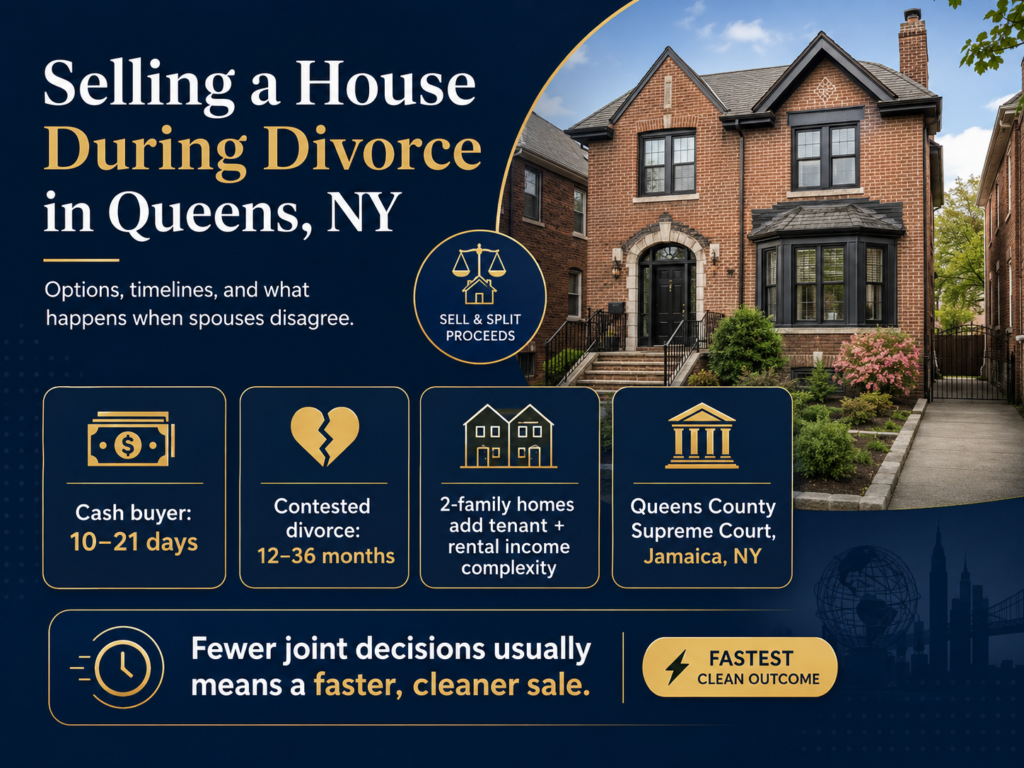
Selling a house during a divorce in Queens involves two simultaneous processes: the legal dissolution of the marriage and the sale of a significant shared asset. Each has its own timeline, its own decision points, and its own pressure. When one process stalls, it affects the other. When both parties disagree, the cost — financial and personal — compounds every month the property sits.
This guide covers how New York handles the marital home in divorce, what happens when spouses disagree on selling, the unique complexities of Queens two-family homes in divorce proceedings, and which selling method produces the fastest clean outcome for both parties.
Legal note: This guide provides general information about New York divorce law and real estate. It is not legal advice. Consult a New York divorce attorney before making any decisions about your specific situation. Real estate decisions made during divorce without proper legal guidance can affect your final settlement.
Table of Contents
- New York Equitable Distribution: How the Marital Home Is Treated
- Queens County Supreme Court: Where Divorce Happens
- Two-Family Homes in Divorce: A Queens-Specific Complication
- Your Options for the Marital Home in Queens
- When a Spouse Won’t Agree to Sell
- Which Selling Method Produces the Fastest Clean Outcome
- Net Proceeds: What Each Party Actually Receives
- Practical Steps for Selling During Divorce in Queens
- Frequently Asked Questions
New York Equitable Distribution: How the Marital Home Is Treated
New York is an equitable distribution state — meaning marital property is divided fairly, but not necessarily equally. The marital home is typically the largest asset in the estate and receives significant attention in the divorce proceedings.
What Counts as Marital Property?
Generally, any property acquired during the marriage — including the Queens home, its appreciated value, and any rental income from a two-family unit — is considered marital property subject to equitable distribution. Separate property — property owned before the marriage or received as a gift or inheritance during the marriage — may be excluded, but the line can blur if marital funds were used for mortgage payments or improvements.
Factors That Affect Distribution
New York courts consider multiple factors when dividing the marital home, including the duration of the marriage, each spouse’s income and earning capacity, the needs of any children (particularly school district considerations in Queens), contributions made by each party to the property, and whether one spouse is the primary custodial parent who may have a right to remain in the home temporarily.
Queens-specific factor: The rental income from a two-family home has been part of the marital household’s finances. Courts will consider this income history — including whether it was reported, how it was used, and what the current market rent versus actual rent represents — as part of the overall asset valuation.
Queens County Supreme Court: Where Divorce Happens
All Queens divorce proceedings are handled at Queens County Supreme Court, 88-11 Sutphin Boulevard, Jamaica, NY 11435 — the same building complex where foreclosure actions and probate matters are processed. If your divorce involves contested property decisions, those matters are heard by a Supreme Court Justice in Jamaica.
Uncontested divorces in Queens — where both parties agree on all terms including property disposition — can be finalized in 3 to 6 months. Contested divorces involving property disputes typically take 12 to 36 months and involve significantly higher legal costs for both parties.
Two-Family Homes in Divorce: A Queens-Specific Complication
Queens’ high concentration of two-family homes creates divorce complications that do not exist in single-family sales — and that many divorce attorneys who are not Queens-specific may not anticipate.
The Rental Income Valuation Problem
A Queens two-family home has two distinct values: the market value as a property sale and the income value based on rental income. If the tenants are paying below-market rent — common in long-term Queens tenancies — the sale price may reflect the income value rather than the full market value. Both parties need to understand which valuation method the buyer is using and how it affects their respective share of proceeds.
One Spouse Occupies One Unit, Tenants in the Other
The most common Queens two-family divorce scenario: one spouse lives in one unit while tenants occupy the other. Selling this configuration requires:
- Agreement between both spouses on the sale terms
- Proper notice to tenants under NYC law (30 to 90 days depending on tenancy length)
- Access for showings coordinated with the occupying spouse and the tenants
- Decision on whether to sell occupied or pursue vacancy first
A cash buyer who specializes in occupied Queens two-family properties resolves most of these complications by purchasing the property as-is, with tenants in place, on a timeline agreed by both spouses.
Rental Income During the Pending Sale
While the property is on the market, rental income from the tenant unit continues. Both parties typically have equal claim to this income during the divorce proceedings. A written agreement — drafted by attorneys — should specify how this income is collected, held, and ultimately allocated. Disputes over rental income during the sale process are one of the most common sources of conflict in Queens two-family divorce sales.
Do not stop collecting rent: Allowing tenants to fall behind on rent during a divorce, or accepting informal arrangements, can create legal complications that affect both the property’s value and the eventual sale. Rent collection should continue normally through the sale process.
Your Options for the Marital Home in Queens
Option 1: Sell the Property and Split Proceeds
The cleanest resolution. Both parties agree to sell, the net proceeds are divided per the divorce settlement, and both move on with liquid assets rather than shared real estate obligations. A written agreement specifying the listing price floor, which selling method to use, how decisions are made, and how proceeds are allocated is essential before any marketing begins.
Option 2: One Spouse Buys Out the Other
One spouse pays the other for their share of the equity and takes full ownership of the property. This requires the buying spouse to qualify for refinancing in their name alone — a significant hurdle if the property carries a large mortgage at current interest rates. A professional appraisal establishes the property’s fair market value for the buyout calculation.
Option 3: Deferred Sale (Nest Egg Agreement)
Both parties agree to delay the sale — typically until children finish school or another defined trigger event. The occupying spouse continues paying the mortgage and receives credit for those payments. This arrangement requires a detailed written agreement and ongoing cooperation between parties — which is why it frequently breaks down and ends in contested proceedings.
Option 4: Court-Ordered Sale
If both parties cannot agree, either spouse can ask the court to order a sale of the property. A court-ordered sale typically results in a lower sale price (because speed is prioritized over optimization), higher legal costs for both parties, and a less favorable outcome than a negotiated sale. Courts in Queens generally prefer the parties to reach agreement and will order a sale as a last resort.
When a Spouse Won’t Agree to Sell
If one spouse refuses to participate in the sale — refusing to sign listing agreements, blocking showings, or obstructing the process — the other spouse has legal remedies through Queens County Supreme Court.
The court can appoint a referee to oversee the sale, issue contempt orders against an uncooperative spouse, and ultimately order a partition sale of the property. However, every step through the court system adds months and legal costs. Mediation with a Queens-experienced family law mediator is almost always faster and less expensive than litigation.
Do not take unilateral action: Attempting to sell the marital home without the other spouse’s participation or court authorization can result in the transaction being voided and expose you to contempt of court. All sale decisions must either have both parties’ agreement or court authorization.
Which Selling Method Produces the Fastest Clean Outcome
| Method | Speed | Requires Both Parties to Agree On | Risk of Process Breakdown |
|---|---|---|---|
| Cash buyer | 10–21 days | One decision: accept or decline the offer | Low — minimal ongoing interaction required |
| As-is MLS listing | 45–75 days | Listing price, agent selection, showing schedule, offer acceptance | Moderate — multiple decision points |
| Traditional listing | 90–150+ days | All of the above plus repair decisions, price reductions | High — prolonged cooperation required |
| Court-ordered sale | 6–18 months | Nothing — court controls process | Very high legal costs; lowest net proceeds |
A cash sale simplifies the divorce property transaction to the fewest number of joint decisions. In situations where cooperation between spouses is strained, this matters enormously. A concrete written offer on the table often resolves disagreements that had seemed intractable — because both parties can finally see the actual number rather than arguing about hypothetical listing prices.
Net Proceeds: What Each Party Actually Receives
The split of proceeds is typically specified in the divorce settlement agreement. Understanding what the net proceeds actually are — after all costs — is essential for both parties to negotiate an informed settlement.
| Cost Item | Cash Buyer | Traditional Listing |
|---|---|---|
| Sale price (example) | $730,000 | $900,000 |
| Agent commission (5.5%) | $0 | −$49,500 |
| NYC Transfer Tax (1.425%) | $0 (buyer covers) | −$12,825 |
| NY State Transfer Tax (0.4%) | $0 (buyer covers) | −$3,600 |
| Mortgage payoff | −$420,000 | −$420,000 |
| Attorney and closing costs | −$2,500 | −$5,000 |
| Repairs / carrying costs | $0 | −$35,000 |
| Net proceeds to split | $307,500 | $374,075 |
| Each party’s share (50/50) | $153,750 | $187,038 |
| Timeline | 14 days | 4–5 months |
The real gap per party: $33,288. For many divorcing couples, receiving $153,750 in 14 days and moving forward is worth $33,288 more than receiving $187,038 in 5 months while continuing to share a property, make joint decisions, and incur carrying costs during an already difficult period.
Practical Steps for Selling During Divorce in Queens
Step 1: Get a Written Agreement Before Any Marketing
Before contacting any buyer or agent, both parties — through their attorneys — should document: the minimum acceptable sale price, which selling method to use, how decisions are made if offers don’t meet the minimum, how proceeds are allocated at closing, and how rental income from a two-family is handled during the process.
Step 2: Get a Professional Appraisal
A formal appraisal from a Queens-experienced appraiser establishes fair market value for the buyout calculation (if one spouse is buying the other out) or as a reference point for listing price negotiations. Both parties should agree on the appraiser to avoid disputes about methodology.
Step 3: Check DOB and HPD Violations
Open violations discovered at title search — after weeks of sales process — derail transactions at the worst possible time in a divorce context. Check nyc.gov/buildings and nyc.gov/hpd before any listing or buyer contact. Decide jointly how to handle any open violations.
Step 4: Request Multiple Cash Offers Simultaneously
Contact three to five verified cash buyers and request offers simultaneously. Having multiple offers in hand gives both parties a concrete set of numbers to evaluate — removing the abstraction that makes negotiations difficult. Competition between buyers also produces better offers.
Step 5: Retain a Real Estate Attorney Immediately
New York requires attorney representation at every real estate closing. In a divorce context, each spouse should have their own attorney review the purchase agreement — not just the divorce attorney. The real estate attorney’s job is to ensure the transaction terms are exactly what was agreed and the closing proceeds correctly.
Can I sell my Queens house during a divorce without my spouse’s signature?
No. If the property is jointly owned, both spouses must sign the contract of sale and the closing documents. There are no exceptions. If one spouse refuses to sign, the other must seek a court order requiring cooperation or authorizing a partition sale. Attempting to sell without the other spouse’s signature will result in the transaction being voided.
What happens to the Queens two-family rental income during the divorce?
Rental income from a jointly owned two-family home during a divorce is typically considered marital income and subject to equitable distribution. Courts expect both parties to continue collecting rent normally during the proceedings. The allocation of this income should be specified in a written agreement drafted by the divorce attorneys. Do not allow tenants to stop paying rent or make informal arrangements during the divorce process.
Does the divorce have to be finalized before we can sell the Queens house?
No. The property can be sold at any point during the divorce proceedings as long as both parties agree. Many couples sell the marital home before the divorce is finalized and hold the net proceeds in escrow until the final settlement specifies the distribution. A cash sale — with its short closing timeline — can actually provide both parties with liquidity while the divorce proceedings continue.
Can a cash buyer close on a Queens divorce property quickly?
Yes. A verified cash buyer can close in 10 to 21 days from accepted offer — requiring only one joint decision (accept or decline the offer) and minimal ongoing cooperation between spouses thereafter. This is the primary reason cash sales are often the preferred path for divorcing couples: fewer decision points means fewer opportunities for the process to stall.
What if one spouse is living in the Queens house and won’t leave for showings?
If one spouse is occupying the property and blocking access for showings or inspections, this constitutes interference with the sale and can be addressed through Queens County Supreme Court. A court order can require the occupying spouse to provide reasonable access for showings with proper notice. A cash buyer who does not require extensive showings or inspection access — purchasing as-is with a single walkthrough — often sidesteps this issue entirely.
How are capital gains taxes handled when selling a Queens house in divorce?
When a married couple sells their primary residence, they may qualify for the $500,000 capital gains exclusion (for couples filing jointly). In a divorce context, the timing of the sale relative to the final decree affects which exclusion applies. If sold before the divorce is finalized, the couple may still qualify for the $500,000 joint exclusion. After divorce, each individual may qualify for a $250,000 exclusion if residency requirements are met. Consult a CPA familiar with NYC real estate and divorce tax implications before closing.
A concrete cash offer on the table changes the dynamic of divorce property negotiations. It removes the abstraction of hypothetical listing prices and gives both parties a real number to evaluate. Getting an offer costs nothing and takes 15 minutes — and for many divorcing Queens homeowners, it is the catalyst that moves a stalled negotiation forward.
Get a Free Cash Offer →