
Sell a House As-Is in Queens, NY: What It Means, What You Get, What to Expect (2026)
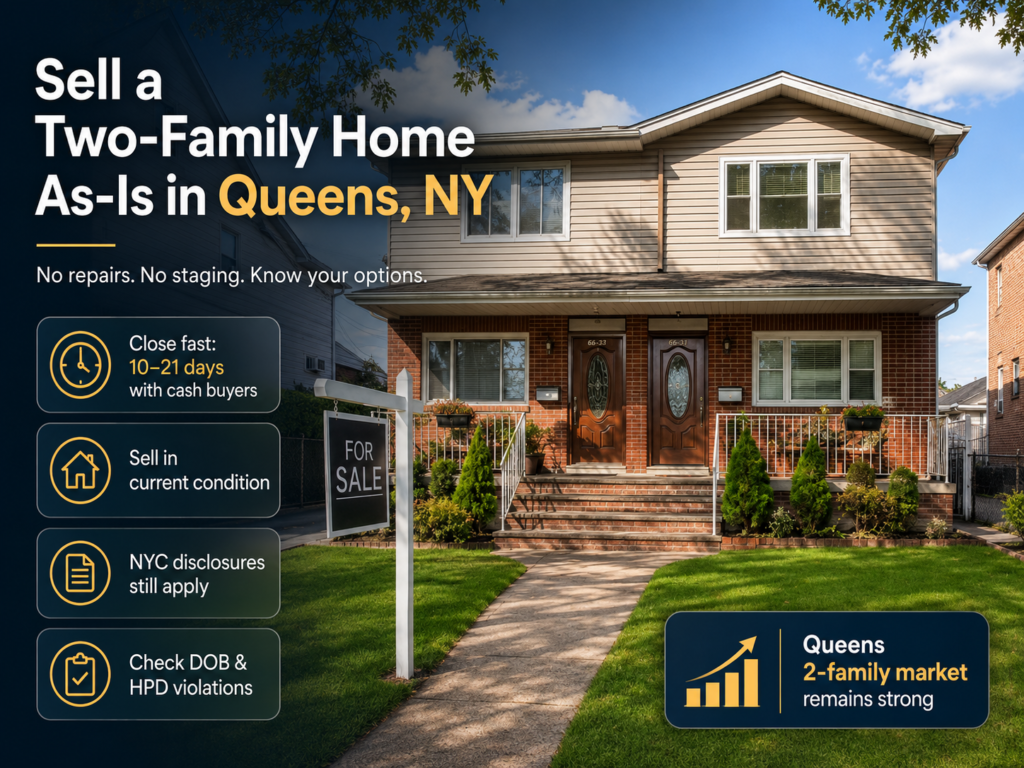
Yes, you can sell a house as-is in Queens, NY — and in the right situation, it is the smartest financial move available. Selling as-is means the property transfers in its current condition. No repairs. No staging. No renovation budget required. The buyer accepts the home knowing exactly what they are getting.
What most Queens homeowners do not realize is that selling as-is does not automatically mean accepting a low offer. It means eliminating the time, cost, and uncertainty of preparing a home for the traditional market. In Queens’ 2026 market — where median two-family homes sell for $990,000 and investor demand is strong — that trade-off is often worth more than it appears on paper.
Table of Contents
- What As-Is Actually Means Under New York Law
- NYC Disclosure Rules: What You Must Reveal
- Who Buys As-Is Homes in Queens
- How Buyers Calculate As-Is Offers in Queens
- Does Selling As-Is Lower Your Price? The Real Math
- Co-ops and Condos: A Special Case
- When As-Is Makes Sense — and When It Doesn’t
- How to Sell As-Is in Queens: Step by Step
- Frequently Asked Questions
What As-Is Actually Means Under New York Law
In real estate, “as-is” is a defined term with legal implications — not just a casual description of condition. Understanding the legal meaning matters before you list or accept any offer in Queens.
Selling as-is in New York means the seller is not agreeing to make any repairs, corrections, or improvements before closing. The buyer agrees to purchase the property in its current condition — including all known and visible defects. But this does not eliminate your disclosure obligations.
Key point: Selling as-is limits your obligation to fix problems. It does not limit your obligation to disclose known ones. Concealing a known material defect in New York can expose you to legal liability after closing — even in an as-is sale.
NYC Disclosure Rules: What You Must Reveal
Queens sellers face disclosure requirements at both the state and city level — more layered than in Nassau or Suffolk County.
New York State Property Condition Disclosure Statement
New York requires sellers to complete a Property Condition Disclosure Statement (PCDS) covering structural conditions, water damage, environmental issues, and other known material defects. Alternatively, sellers can offer the buyer a $500 credit at closing in lieu of completing the PCDS. Either way, you cannot conceal known material defects.
NYC-Specific Disclosures
Queens sellers also have additional NYC-specific disclosure obligations that do not apply in Nassau or Suffolk:
- Lead paint disclosure — required for pre-1978 properties (most of Queens’ housing stock)
- Open DOB violations — buyers are entitled to know about open Department of Buildings violations on the property
- HPD violations — for multi-family properties, open Housing Preservation and Development violations must be disclosed
- Bedbug history — NYC Local Law 69 requires disclosure of bedbug infestation history in multi-unit buildings
Practical step: Before listing or contacting any buyer, check your property’s DOB violation status at nyc.gov/buildings and HPD status at nyc.gov/hpd. Buyers and their attorneys will check these databases — knowing your status upfront prevents closing surprises.
Who Buys As-Is Homes in Queens
Cash Buyers and Real Estate Investors
The most active purchasers of as-is properties in Queens. They purchase homes in any condition, move quickly, and don’t require mortgage financing. Cash buyer activity in Queens is highest in Jamaica, South Jamaica, Hollis, St. Albans, Queens Village, Ozone Park, Richmond Hill, and Woodhaven — communities where post-renovation values are strong and investor activity is consistent.
Fix-and-Flip Investors
A subset of cash buyers who purchase specifically to renovate and resell within 6 to 18 months. Fix-and-flip buyers in Queens are particularly active in neighborhoods where renovated homes sell quickly at strong premiums. They evaluate properties based on the ARV formula — what the home will be worth renovated — minus their cost projections.
Owner-Occupant Buyers Seeking Value
Some financed buyers specifically target as-is properties they plan to renovate to their own taste. These buyers can offer prices closer to market value than investors — but their lender may require repairs as a condition of financing, which complicates the transaction. FHA and VA loans have minimum property standards that many distressed Queens properties cannot meet without remediation.
Multi-Family Specialists
For Queens two-family and three-family as-is sales, buyers who specialize in occupied multi-family properties are often the most practical option. They understand NYC tenant law, open violations, and income-based valuation — and purchase without requiring vacancy or remediation.
How Buyers Calculate As-Is Offers in Queens
Every serious cash buyer in Queens uses a version of the same formula. Understanding it before you receive any offer is the most useful preparation you can do.
The ARV Formula: Maximum Offer = (ARV × 65–75%) − Estimated Repair Costs
ARV = After Repair Value — what the home will be worth once fully renovated, based on recent comparable sales of renovated properties in your Queens neighborhood.
A Real Queens Example
| Variable | Amount | Notes |
|---|---|---|
| ARV (renovated comps in your neighborhood) | $780,000 | Recent sales of finished single-family homes nearby |
| × 70% multiplier | $546,000 | Standard investor margin in Queens |
| − Estimated repair costs | −$75,000 | Buyer’s estimate — always verify this number |
| = Maximum offer | $471,000 | Starting point for negotiation |
Negotiation leverage: If a buyer’s repair estimate is $20,000 too high — which you can demonstrate with contractor quotes — that translates directly to a $14,000 higher offer at 70% formula. Repair estimates are the most negotiable variable. Always question them and get independent quotes if you have time.
Factors That Strengthen an As-Is Offer in Queens
- Strong location — properties in Bayside, Forest Hills, Astoria, or Flushing command premiums even in poor condition due to high ARVs
- High ARV relative to repair costs — a home needing $40,000 in work in an $850,000 ARV market produces a much stronger offer than the same repairs in a $500,000 market
- Clean title — no open violations, no tax liens, no ownership disputes
- Cosmetic vs. structural — properties needing paint, flooring, and kitchen updates receive better offers than those with foundation, roof, or structural issues
- For two-family homes — strong rental income supports income-based valuation that can exceed the ARV formula result
Does Selling As-Is Lower Your Price? The Real Math
The honest answer: sometimes yes, sometimes it is essentially a wash. The difference depends on what you would have spent preparing the home for a traditional listing — and how long you would have waited.
| Cost Item | Traditional Listing | As-Is Cash Sale |
|---|---|---|
| Sale price | $870,000 | $710,000 |
| Agent commission (5.5%) | −$47,850 | $0 |
| NYC Transfer Tax (1.425%) | −$12,398 | $0 (buyer covers) |
| NY State Transfer Tax (0.4%) | −$3,480 | $0 (buyer covers) |
| Repairs before listing | −$55,000 | $0 |
| Carrying costs (4 months) | −$22,000 | $0 |
| Attorney and closing costs | −$5,000 | $0 |
| Net proceeds | $724,272 | $710,000 |
| Timeline | 5–6 months | 14 days |
The real gap in this example is $14,272 — not $160,000. For many Queens homeowners, selling as-is to a cash buyer and closing in two weeks is worth $14,272. Run this calculation with your actual numbers before assuming the traditional route produces meaningfully more money.
Co-ops and Condos: A Special Case
Queens has a meaningful inventory of co-op apartments — particularly in Forest Hills, Rego Park, Flushing, and Jamaica — and the as-is sale rules are fundamentally different for co-ops than for houses.
Co-ops Cannot Typically Be Sold As-Is to Cash Buyers
Co-op boards have the right to approve or reject all buyers, regardless of whether the sale is as-is or traditionally listed. A cash buyer who purchases investment properties cannot typically satisfy a co-op board’s financial requirements (most boards require owner-occupancy or specific financial profiles). Selling a co-op as-is to an investor is rarely feasible.
Condos Are More Flexible
Condos in Queens can be sold as-is to cash buyers more easily than co-ops, since condo boards have more limited rights of first refusal and approval. However, the buyer will still need to comply with any condo association rules, and the HOA’s financial health affects financed buyers’ lender approval.
For Houses and Two-Family Homes
The as-is sale process described throughout this article applies fully to single-family and multi-family houses in Queens, which make up the majority of the as-is market.
When As-Is Makes Sense — and When It Doesn’t
As-Is Makes Strong Sense When:
- The property needs $40,000 or more in repairs and you don’t have the capital or time to manage a renovation
- You need to close within 30 days or less
- The property is inherited and you don’t want to invest in a home you never planned to keep
- You are facing pre-foreclosure and need to close before a filing date at Queens County Supreme Court
- The property has structural, environmental, DOB violations, or mechanical issues that would likely kill a traditional sale during inspection
- You own a tenant-occupied two-family and want to avoid the complexity of vacancy negotiations
- You are going through a divorce and both parties want a clean, fast transaction
As-Is May Not Be the Best Move When:
- Your home is in good condition needing only minor cosmetic updates — a $10,000 investment could add $40,000 to your sale price
- You have 60 to 90 days and no financial urgency — a traditional listing is likely to net more
- Your Queens submarket has very high demand (Astoria, Bayside, Forest Hills) — competitive bidding on a prepared listing could significantly outperform any as-is offer
- The property is a co-op — cash buyers are typically not viable for co-op sales
How to Sell As-Is in Queens: Step by Step
Step 1: Check Your DOB and HPD Violations
Before contacting any buyer, verify your violation status at nyc.gov/buildings and nyc.gov/hpd. Some violations resolve quickly; others require contractor work. Knowing your status upfront allows you to price expectations correctly and avoid closing delays.
Step 2: Get a Realistic As-Is Value Estimate
Request a cash offer from two or three verified buyers, and get a CMA (comparable market analysis) from a local Queens agent. These two numbers — the cash offer and the estimated MLS price — are the anchors for your decision. Calculate net proceeds for both scenarios using the framework above.
Step 3: Complete Your Disclosure Obligations
Complete the PCDS or offer the $500 credit alternative. Document known defects accurately. Have your attorney review what NYC-specific disclosures apply to your specific property type.
Step 4: Choose Your Path and Verify Your Buyer
If you choose a cash buyer: confirm proof of funds, a verifiable Queens track record, no upfront fees, and a written offer with transparent terms. If you choose an as-is MLS listing: confirm your agent’s experience with Queens as-is sales and investor buyers.
Step 5: Retain Your Attorney Before Signing
Every New York closing requires attorney representation. Retain yours before accepting any offer — not after — so contract review begins immediately upon acceptance.
Do I have to disclose problems if I sell as-is in Queens?
Yes. Selling as-is limits your obligation to fix problems — it does not eliminate your obligation to disclose known material defects. In addition to the NY State PCDS requirement, Queens sellers face NYC-specific disclosures including lead paint, open DOB violations, HPD violations, and bedbug history for multi-unit properties. Failing to disclose a known material defect can expose you to legal liability after the sale.
Can a cash buyer purchase a Queens house as-is if it has open DOB violations?
Yes. Cash buyers specifically target properties with open violations because they have the resources and contractor relationships to resolve them. A financed buyer’s lender may refuse to fund a mortgage on a property with certain open violations — creating complications that a cash buyer sidesteps entirely. Open violations are disclosed, factored into the offer, and resolved by the buyer after closing.
Can I sell a Queens co-op as-is?
Selling a co-op as-is to an investor or cash buyer is generally not feasible because co-op boards have approval rights over all buyers and typically require owner-occupancy. You can sell a co-op in its current condition on the open market, but the buyer pool is limited to individuals who can satisfy board requirements — not investment buyers.
Will a buyer’s mortgage lender allow an as-is purchase in Queens?
It depends on condition and loan type. FHA and VA loans have minimum property standards — if the Queens home does not meet them, these loans will not be approved. Conventional loans are more flexible but may still require certain repairs as a condition of financing. Cash buyers have no lender requirements, which is why they can purchase truly distressed Queens properties that financed buyers cannot.
How long does an as-is sale take in Queens?
With a cash buyer: 10 to 21 days from accepted offer to closing. With an as-is listing on the MLS to a financed buyer: typically 45 to 75 days depending on buyer financing, lender requirements, and whether any repairs are demanded as a loan condition. Either path is significantly faster than a traditional prepared listing in Queens.
Is selling as-is the same as selling to a cash buyer in Queens?
No. As-is describes the condition of the sale — no repairs before closing. Cash buyer describes the type of buyer — one who does not use mortgage financing. Many cash buyers do purchase as-is, but you can also sell as-is through a traditional MLS listing to a financed buyer. The two terms are related but not interchangeable.
Getting a cash offer costs nothing and takes 15 minutes. It gives you the real number to compare against what a traditional listing would net — and most Queens homeowners who run this comparison are surprised by how close the numbers actually are.
Get a Free Cash Offer →