
Selling an Inherited House in Queens, NY: What You Need to Know (2026)
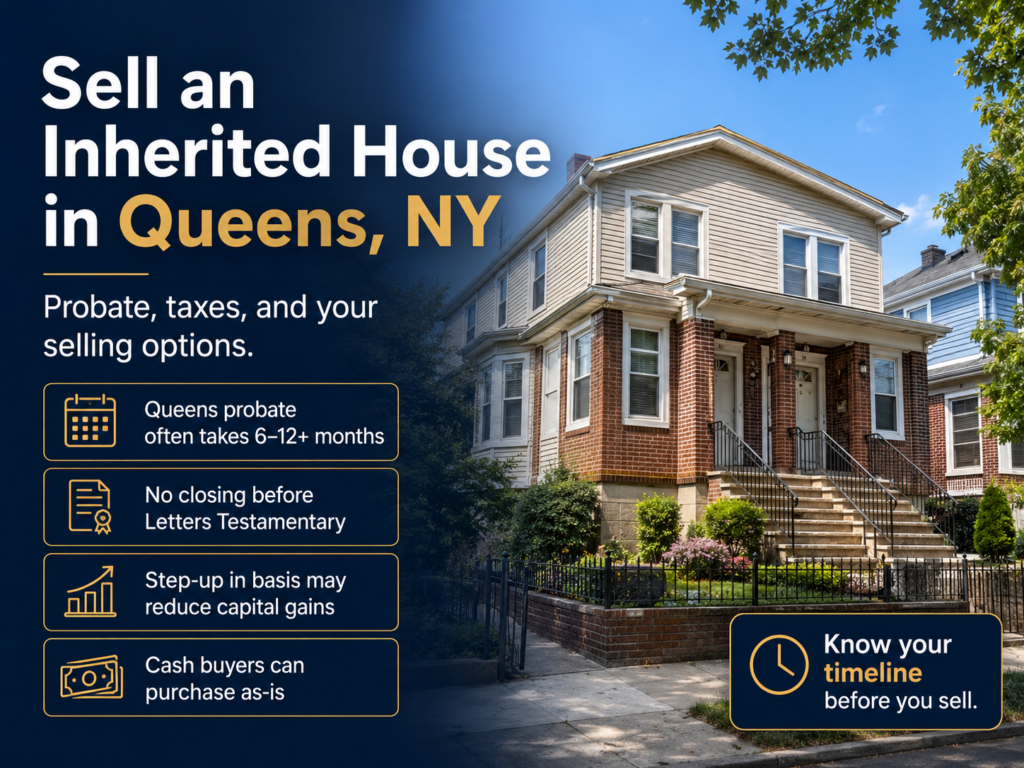
Inheriting a house in Queens comes with legal obligations, tax implications, and decisions most people have never had to make before — often while managing grief and family dynamics at the same time. This guide covers what actually matters: how New York probate works specifically in Queens County, what taxes apply, whether you can sell before probate closes, and how to decide between selling fast and renovating.
The information here is specific to Queens County and New York State. General real estate advice often does not apply because Queens probate and NYC tax law differ significantly from other states — and from Nassau and Suffolk Counties.
Legal note: This guide provides general information about New York probate and tax law as it commonly applies to inherited property in Queens. It is not legal or tax advice. Consult a New York estate attorney and a CPA before making decisions about your specific situation.
Table of Contents
- Understanding Probate in Queens County
- Queens County Surrogate’s Court: What You Need to Know
- Can You Sell Before Probate Is Finished?
- Taxes on Inherited Property in Queens
- Carrying Costs During Probate in Queens
- Selling Fast vs. Renovating: The Real Math
- Multiple Heirs and Disagreements
- Practical Steps to Sell an Inherited House in Queens
- Frequently Asked Questions
Understanding Probate in Queens County
Probate is the legal process by which a deceased person’s estate is administered, debts are settled, and assets — including real property — are transferred to heirs. In New York State, probate is handled through the Surrogate’s Court in the county where the deceased person lived.
When Is Probate Required?
| Ownership Structure | Probate Required? | What Happens |
|---|---|---|
| Solely in deceased’s name (with will) | Yes | Executor named in will petitions Surrogate’s Court |
| Solely in deceased’s name (no will) | Yes — intestate | Administrator appointed by court; heirs per NY law |
| Joint tenancy with right of survivorship | No | Surviving owner inherits automatically |
| Tenancy by the entirety (spouses) | No | Surviving spouse inherits automatically |
| Living trust | No | Trustee transfers per trust terms |
| Co-op shares | Yes (in most cases) | Shares go through probate; co-op board approval required for transfer |
Queens-specific note: If the inherited property is a co-op apartment — common in Forest Hills, Rego Park, Flushing, and Jamaica — the co-op board must approve the transfer of shares to the heir, and any eventual sale is subject to board approval of the buyer. This adds complexity not present in house inheritances.
Queens County Surrogate’s Court: What You Need to Know
All Queens County probate matters are handled at the Queens County Surrogate’s Court, located at 88-11 Sutphin Boulevard, 7th Floor, Jamaica, NY 11435 — the same building complex as Queens County Supreme Court, where foreclosure matters are also handled.
Probate Timeline in Queens County
| Scenario | Estimated Timeline |
|---|---|
| Simple estate, uncontested will, no disputes | 6 to 12 months |
| Moderate complexity (multiple assets, minor creditors) | 12 to 18 months |
| Contested will or disputes among heirs | 18 months to 3+ years |
| No will (intestate), heirs must be identified | 12 to 24 months |
These timelines include the petition filing, the mandatory creditor notification period (typically 7 months from Letters Testamentary issuance), asset inventory, debt settlement, and final distribution. The Queens County Surrogate’s Court calendar adds additional time depending on current caseload.
Letters Testamentary: The Document That Unlocks the Sale
Letters Testamentary are the legal document issued by the Surrogate’s Court that give the executor authority to act on behalf of the estate — including signing a contract of sale. No sale can close without Letters Testamentary. However, once Letters Testamentary are issued, the executor can begin marketing the property and accept an offer even while the rest of the probate process continues.
Can You Sell Before Probate Is Finished?
You cannot complete a sale before the executor has Letters Testamentary. But you can begin marketing, accept an offer, and sign a purchase contract before probate fully closes — as long as the contract is structured to close after the estate is sufficiently settled.
| Approach | When Possible | Advantage | Risk |
|---|---|---|---|
| List and contract during probate | After Letters Testamentary issued | Reduces total time to sale | Closing may be delayed if probate takes longer than expected |
| Wait until probate fully closes | After final decree | Simpler, no timing risk | Adds months or years to the sale timeline |
| Sell to a cash buyer during probate | After Letters Testamentary issued | Cash buyers flex on closing date; no lender deadline pressure | Offer reflects uncertainty premium |
Practical approach: Most Queens estate attorneys recommend accepting an offer and signing a contract during probate, with a closing date scheduled to align with the expected end of the probate period. Cash buyers are particularly well-suited for this because they do not have a lender creating a hard close deadline — they can close in 2 weeks or 6 months, depending on when the estate is ready.
Taxes on Inherited Property in Queens
Tax implications are one of the most misunderstood aspects of inherited property sales. Many Queens heirs significantly overestimate their exposure — and some miss important obligations. Here is what actually applies.
The Step-Up in Basis: The Most Important Tax Rule
When you inherit property in New York, the IRS resets your cost basis to the fair market value of the property on the date of the original owner’s death. This is the step-up in basis.
Queens example: The deceased purchased a two-family home in Hollis in 1988 for $95,000. At the time of death, it was worth $880,000. Your cost basis is $880,000 — not $95,000. If you sell for $900,000, your taxable gain is only $20,000, not $805,000. The step-up effectively eliminates capital gains tax on all appreciation during the original owner’s lifetime.
Given that Queens home values have appreciated dramatically over the past three decades, the step-up in basis is an enormous tax benefit. Most Queens heirs who sell within a reasonable time of inheriting owe little to no capital gains tax.
Capital Gains Tax If You Sell Above Basis
| Holding Period After Inheritance | Tax Treatment | Federal Rate (2026) |
|---|---|---|
| Any period — inherited property always gets long-term treatment | Long-term capital gains | 0%, 15%, or 20% depending on income |
| Property used as primary residence 2+ of last 5 years | May qualify for $250K/$500K exclusion | Potentially $0 |
New York State Estate Tax
New York State imposes its own estate tax with a 2026 exemption of approximately $7.16 million. New York’s “cliff” provision means that if the estate’s value exceeds the exemption by more than 5%, the entire estate becomes taxable — not just the amount above the exemption. For most Queens heirs inheriting a single residential property, the estate value falls below the threshold and no NY estate tax is owed.
NYC Transfer Taxes at Closing
When an inherited Queens property sells, standard NYC transfer taxes apply — the same as any Queens sale. NYC Transfer Tax: 1% on sales under $500,000 or 1.425% on sales of $500,000 or more. NY State Transfer Tax: 0.4%. On a $900,000 Queens inherited property sale, combined transfer taxes total approximately $16,860. Many cash buyers cover these costs — always confirm in writing.
Carrying Costs During Probate in Queens
Property taxes in Queens do not pause during probate. The estate is responsible for continued payment of NYC property taxes until the property is sold or transferred.
| Carrying Cost | Monthly | Annual |
|---|---|---|
| NYC property taxes (Queens Class 1 average) | $440–$760 | $5,280–$9,120 |
| Homeowners insurance | $175–$350 | $2,100–$4,200 |
| Utilities (minimal occupancy) | $200–$400 | $2,400–$4,800 |
| Total carrying cost (no mortgage) | $815–$1,510 | $9,780–$18,120 |
Note: Queens property taxes are significantly lower than Nassau or Suffolk due to NYC’s Class 1 effective rate of approximately 0.88%. However, a 12-month probate still costs the estate $9,780 to $18,120 in carrying costs before accounting for any deferred maintenance. An 18-month probate adds 50% more. These costs reduce net proceeds from any eventual sale.
Selling Fast vs. Renovating: The Real Math for Queens
| Scenario | Sell As-Is (Cash Buyer) | Renovate Then List |
|---|---|---|
| Estimated sale price | $680,000 | $860,000 |
| Agent commission (5.5%) | $0 | −$47,300 |
| NYC Transfer Tax (1.425%) | $0 (buyer covers) | −$12,255 |
| NY State Transfer Tax (0.4%) | $0 (buyer covers) | −$3,440 |
| Renovation investment | $0 | −$65,000 |
| Carrying costs (7 months) | $0 | −$8,400 |
| Attorney and closing costs | $0 | −$5,000 |
| Net proceeds | $680,000 | $718,605 |
| Additional net from renovating | — | +$38,605 |
| Time required | 3 weeks | 7–10 months |
| Capital required upfront | $0 | $65,000 |
In this example, renovation produces $38,605 more in net proceeds — but requires 7 to 10 months and $65,000 in capital that must be available before receiving any sale proceeds. For co-heirs who need to distribute proceeds quickly, or who don’t have access to renovation capital, the cash sale is the rational choice even at lower net proceeds.
Multiple Heirs and Disagreements
If a Queens property is inherited by multiple heirs who cannot agree on whether to sell, one heir can petition the Surrogate’s Court for a partition action — a legal proceeding that can force the sale of the property and divide the proceeds. Partition actions in Queens are expensive and adversarial. In most cases, mediation or facilitated negotiation with a New York estate attorney is significantly faster and less costly.
Warning: If you are in a multi-heir situation with disagreements about selling, get legal counsel before taking any action. Selling without all required heirs’ consent can expose the executor to personal liability.
Practical Steps to Sell an Inherited House in Queens
Step 1: Determine How the Property Is Titled
Confirm how the property was held — solely in the deceased’s name, as joint tenancy, through a trust, or as tenancy in common. For co-ops, confirm how the shares were held. A real estate attorney can determine this from the deed or co-op proprietary lease in minutes.
Step 2: Open Probate at Queens County Surrogate’s Court
The executor files a petition at 88-11 Sutphin Blvd, 7th Floor, Jamaica, NY 11435. The court reviews the will, appoints the executor, issues Letters Testamentary, and opens the estate. Filing fees are based on the estate’s value.
Step 3: Get a Date-of-Death Appraisal
Obtain a formal appraisal of the property’s fair market value as of the date of death. This establishes your stepped-up cost basis for capital gains purposes. A Queens real estate appraiser familiar with local market data can provide a retroactive date-of-death appraisal.
Step 4: Address Carrying Costs Immediately
Ensure NYC property taxes, homeowners insurance, and utilities are current from the moment you take responsibility. Lapsed insurance on an inherited property creates significant liability. Delinquent property taxes in Queens accrue interest through the NYC Department of Finance and can lead to a tax lien.
Step 5: Decide on Your Selling Strategy
Get a cash offer (free, no obligation) and a CMA from a local Queens agent. Run the net proceeds comparison with your specific property numbers. Factor in your timeline, access to renovation capital, number of co-heirs, and carrying costs. Then decide.
Do I pay capital gains tax when I sell an inherited house in Queens?
It depends on whether the sale price exceeds the stepped-up basis. If you sell at or below the fair market value on the date of death, no capital gains tax is owed. If you sell above that value, you pay long-term capital gains tax on the difference at 0%, 15%, or 20% depending on your income. For most Queens heirs who sell within a reasonable time of inheriting, the gain above stepped-up basis is small or zero given decades of appreciation already captured by the step-up.
Can I sell an inherited Queens house before probate is finished?
You can sign a purchase contract and market the property once the executor has Letters Testamentary from the Queens County Surrogate’s Court. The sale typically cannot close until probate is sufficiently advanced or complete. Cash buyers are the most practical option for inherited properties still in probate because they can structure the closing date to align with the estate’s timeline without lender pressure.
How long does it take to sell an inherited house in Queens?
Timeline depends on probate complexity and the selling method. For a standard estate with an uncontested will: probate takes 6 to 12 months, during which you can market and accept an offer. A cash buyer can close within days of probate completing. An MLS listing takes 60 to 90 additional days after an offer is accepted. Total from date of death to closing: typically 9 to 15 months for a standard Queens estate.
Does Queens County have an inheritance tax?
No. New York State does not have an inheritance tax — meaning heirs do not pay tax simply for receiving property. New York does have an estate tax paid by the estate before distribution to heirs, but only for estates exceeding approximately $7.16 million in 2026. Most Queens residential estates fall below this threshold.
Can a cash buyer purchase an inherited Queens property?
Yes. Cash buyers handle inherited properties routinely — including properties in probate, properties with multiple heirs, properties in poor condition, and tenant-occupied two-family homes. They are often the most practical option because they do not require lender approval, can flex on closing dates to accommodate the probate timeline, and purchase as-is without requiring repairs.
What if the inherited property is a co-op in Queens?
Inheriting a co-op involves an additional layer of complexity: the co-op board must approve the transfer of shares to the heir, and any eventual sale requires board approval of the buyer. Cash buyers who purchase investment properties typically cannot satisfy co-op board requirements. Selling an inherited co-op usually means listing on the MLS and targeting qualified owner-occupant buyers who can pass board approval.
Inherited property decisions do not have to be rushed — but they do have a cost of waiting. Every month a Queens property sits during probate costs the estate real money in taxes, insurance, and maintenance. Getting a cash offer costs nothing and gives you a concrete number to anchor your decision.
Get a Free Cash Offer →